Enforcement of EU law in 2023–2025
2026-04-29
The European Parliament has adopted a resolution assessing how the Commission and the Member States applied and enforced EU law between 2023 and 2025. 416 MEPs voted in favour, 190 against, and 15 abstained. The resolution was supported by the EPP, S&D, Renew and Greens/EFA – that is, all four groups of the pro-European majority – and, for the most part, by The Left. The ECR, PfE and ESN – the far-right groups – voted almost unanimously against it.
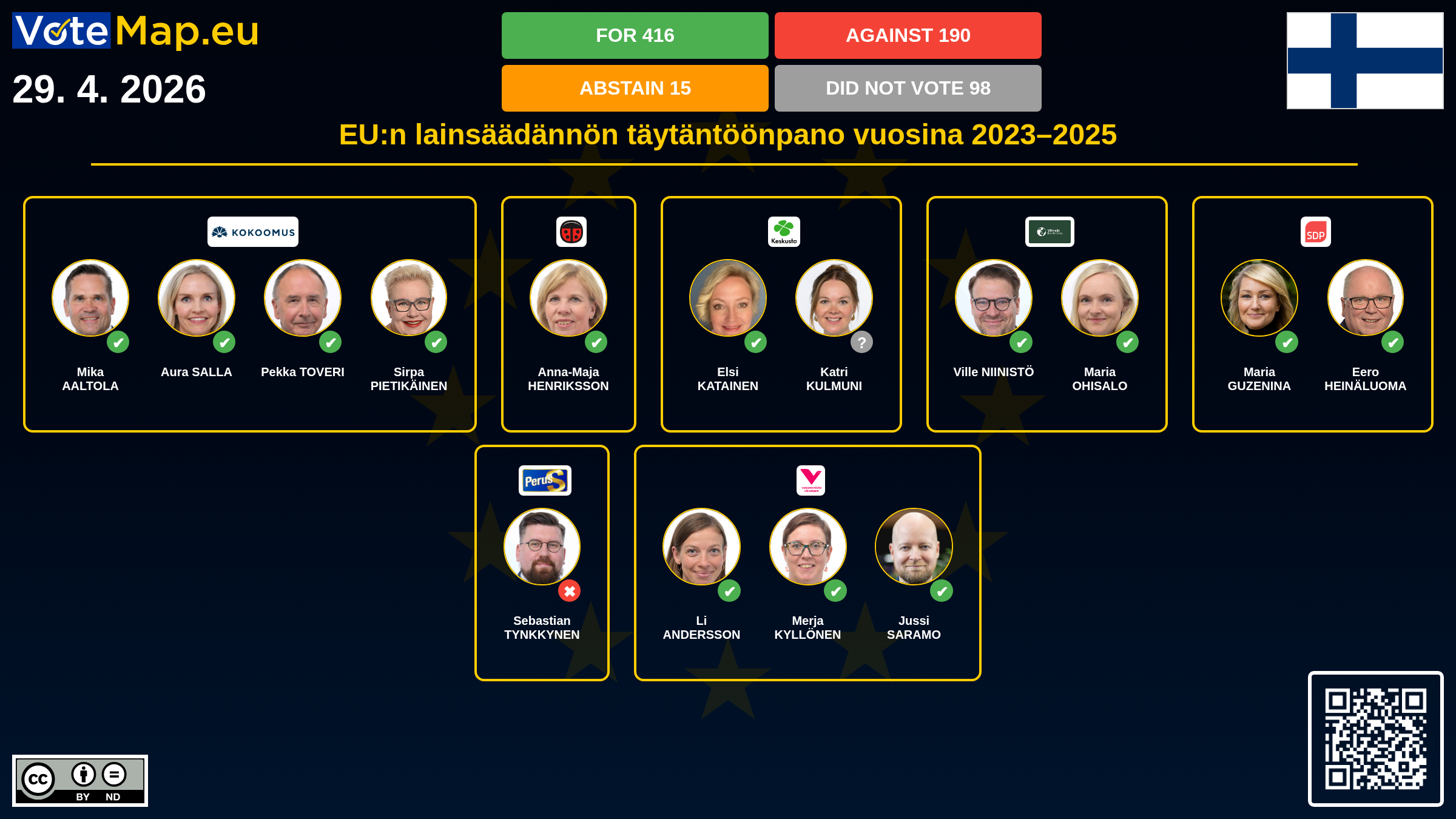
The resolution is based on a report by the JURI Committee, drafted by the rapporteur, Dainius Žalimas of the Renew Group. In the report, the committee assesses how the European Commission and the Member States apply and enforce EU law. The Commission’s main tool is infringement proceedings, which may end up before the Court of Justice of the European Union.
The resolution regrets that the Commission has not published its annual report on the application of EU law for 2024. In doing so, it broke with a practice it had followed since 1983.
The resolution also cites specific figures. The number of infringement proceedings closed fell from 1,030 in 2023 to 535 in 2024. The number of open cases during the same period rose from 1,461 to 1,493, whilst the number of new cases rose from 528 to 567. According to preliminary data, between 1 January and 31 July 2025, 345 proceedings were concluded and 1,559 were active. In all three years, the majority of active proceedings concerned the environment.
Under the resolution, the Commission is to publish transparent and objective criteria for selecting cases for proceedings. It is to consistently initiate proceedings even where a Member State fails to comply with a judgment of the Court of Justice, including proposals for lump-sum payments or penalty payments. The resolution expresses serious concern that the Commission is reluctant to take legal action even in cases of clear and persistent infringements. It calls on Member States to comply with the deadlines for transposing directives into national law; according to the Single Market Scoreboard, the average delay for single market directives is 11.9 months. It also expresses strong support for the conditionality mechanism linked to the rule of law and concern that constitutional and supreme courts in some Member States are undermining the primacy of EU law.
416 MEPs voted in favour of the resolution, 190 against and 15 abstained. All four groups of the pro-European majority supported it almost unanimously: EPP 150 in favour, 2 against and 3 abstentions; S&D: all 118 in favour; Renew: 59 in favour and 1 abstention; Greens/EFA: all 45 in favour. Their key points are reflected in the debate of 28 April 2026.
Rapporteur Dainius Žalimas (Renew) stated when presenting the report: “European law is only as strong as its implementation.” Shadow rapporteur Lukas Mandl (EPP) pointed out that “at Member State level and elsewhere, EU law is sometimes implemented in an even more complicated manner than it actually is at European level”. Shadow rapporteur Eric Sargiacomo (S&D) called on the Commission not to sacrifice “the democratic requirement on the altar of reckless deregulation aimed at short-term gain”. Shadow rapporteur Tineke Strik (Greens/EFA) was the most outspoken in her address to the Commission: “Commissioners, you are the guardians of the Treaties, and so I call on you: do not merely mediate, but also take legal action and put an end to impunity.” The statements are translated from the verbatim record of the debate.
The far-left group The Left voted overwhelmingly in favour: 41 in favour, 1 against, 1 abstention. The far right opposed the motion: ECR 69 votes against and 5 abstentions; PfE 73 against and 2 abstentions; ESN 25 against and 1 abstention. None of the members of these three groups voted in favour. The EPP and the far right did not take part in this vote.
We collect and visually present data publicly available at the page of European Parliament. Votemap.eu denies any responsibility for possible inconsistencies of the data or its changes after the publication.
Descriptions are created using DeepL Translate machine translation. We apologize for any possible imperfections or inconvenience.