The state of fundamental rights in the EU in 2024 and 2025
2026-04-29
The resolution on the state of fundamental rights in the EU was adopted by 328 votes in favour, 199 against and 98 abstentions. The S&D, Renew and Greens/EFA groups voted unanimously in favour, whilst the EPP was divided: 86 in favour, 12 against and 55 abstentions, including the entire delegations of Spain’s PP and Greece’s ND. The pro-European majority therefore did not support the report unanimously. The ECR, PfE and ESN – that is, the far right – voted against. The Left had 12 votes in favour, 1 against and 30 abstentions.
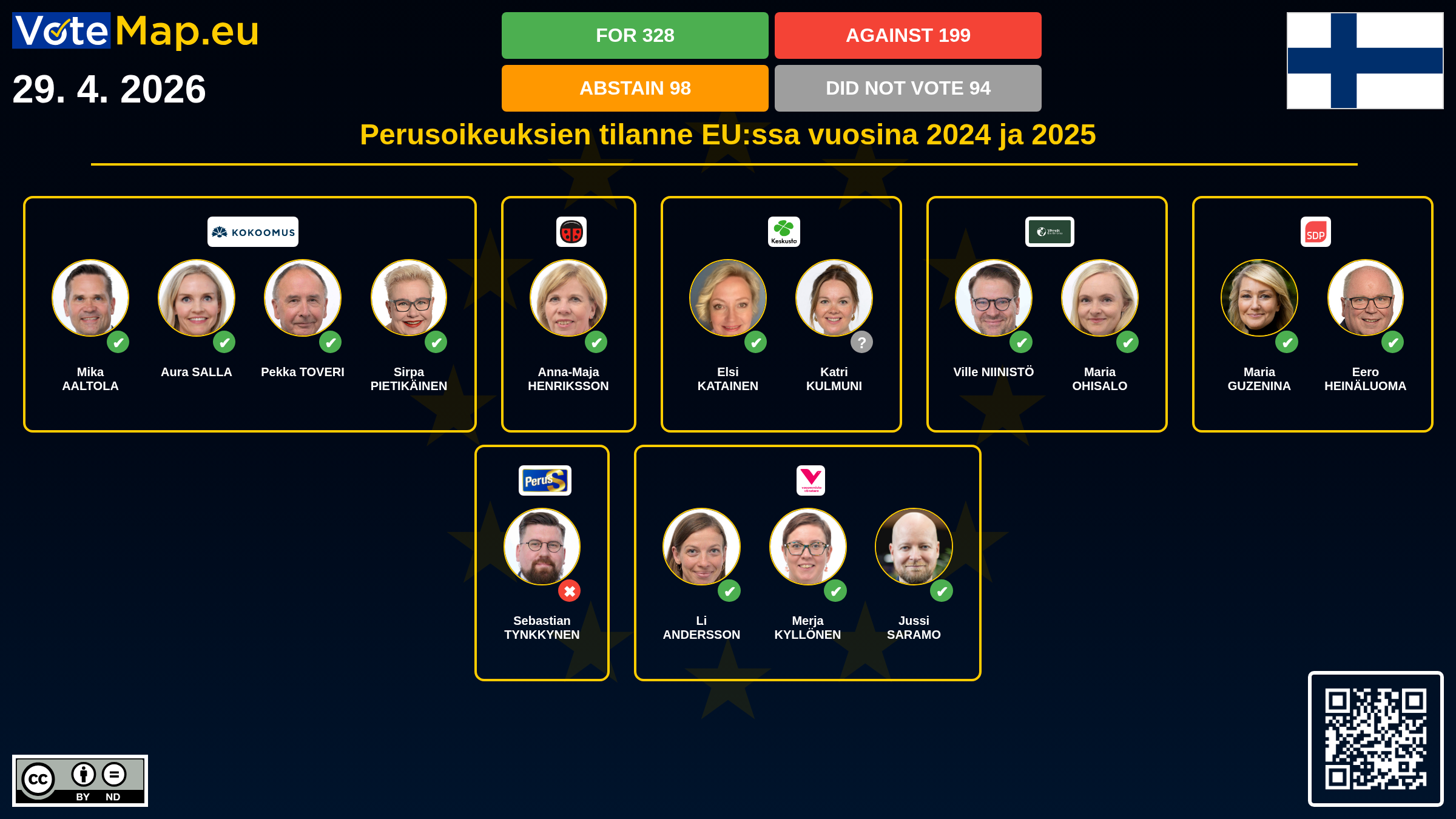
The resolution on the annual report on the state of fundamental rights in the European Union in 2024 and 2025 was adopted by 328 votes in favour, 199 against and 98 abstentions. The report was drawn up by the rapporteur, Anna Strolenberg (Greens/EFA), in the Committee on Civil Liberties, Justice and Home Affairs (LIBE). The vote on the resolution as a whole was preceded by 107 roll-call votes on individual paragraphs, recitals and amendments.
The resolution calls on the Commission and the Member States to systematically assess the impact of legislative proposals on fundamental rights. It expresses serious concern that Hungary continues to violate the values set out in Article 2 of the Treaty on European Union. It notes that the Article 7(1) procedure, which has been ongoing since 2018, has not yielded tangible progress, and therefore calls on the Commission and the Member States to initiate the procedure under Article 7(2). With regard to the Pegasus, Predator and Graphite surveillance programmes, it recalls the recommendations of the PEGA Committee of Inquiry and the Venice Commission and calls for effective judicial oversight of surveillance.
The resolution reiterates the call to include the right to safe and legal abortion in the Charter of Fundamental Rights of the EU. It describes the denial of access to sexual and reproductive health care as a form of gender-based violence. It calls on Member States to recognise feminicide as a separate criminal offence, and on the Council to unblock negotiations on the horizontal anti-discrimination directive. On migration, it reiterates the right to seek international protection and the principle of non-refoulement. In the explanatory statement, it refers to reported cases of people being pushed back across borders.
The S&D (118 in favour), Renew (64 in favour) and Greens/EFA (45 in favour) voted unanimously. None of them voted against or abstained. Rapporteur Strolenberg said at the start of the debate on 28 April 2026: “Are we going to sit here and haggle over people’s rights – who should have more and who deserves less? Or will we be able to live up to the best versions of ourselves and say: ‘these fundamental rights are not up for negotiation’?” At the end of the debate, she acknowledged the criticism that the outcome did not include protection for people protesting in support of the people of Gaza: “I understand this, and I too would have liked it to be part of the negotiated outcome.” Alice Kuhnke (Greens/EFA) said: “The right to make decisions about one’s own body is being called into question, and civil society is under pressure.” Shadow rapporteur Marco Tarquinio (S&D) stated: “…we therefore reject amendments that target the essentials: the rights of children, women, LGBTQ people and the vulnerable in general, particularly as regards migrants…” Shadow rapporteur Lucia Yar (Renew) said: “The erosion of fundamental rights is no accident: it happens when governments […] curtail freedoms in order to consolidate power. […] Just as in Orbán’s case, the European Union cannot remain silent – and will not remain silent – when fundamental rights are being eroded.” The quotes have been translated from English; in the case of Kuhnke, from Swedish; and in the case of Tarquini, from Italian.
The EPP was divided in its vote: 86 MEPs in favour, 12 against and 55 abstentions. The entire delegations of the Spanish People’s Party (PP, 18 MEPs) and the Greek New Democracy (ND, 6 MEPs) abstained. Fifteen out of 21 voting Polish EPP MEPs also abstained, mainly from the Civic Coalition (KO). These three delegations accounted for 39 of the 55 abstentions. The abstentions were concentrated in the final vote. In none of the 107 individual votes did so many EPP MEPs abstain; the highest number was 43. Shadow rapporteur Lukas Mandl (EPP) said during the debate: “Thank you once again for this important report; it is good that Europeans have fundamental rights” (translated from English). The rest of his speech mainly concerned anti-Semitism. It is not clear from the debate why so many EPP MEPs abstained. We have no statement from the group or the national parties concerned regarding this vote.
The Left, that is, the far left, had 12 votes in favour, 1 against and 30 abstentions. Here too, the abstentions were concentrated in the final vote; in the individual votes, no more than 8 of its MEPs abstained. We have no documented reason for this either.
The ECR, PfE and ESN – that is, the far right – voted against. The ECR had 70 votes against, 1 in favour and 6 abstentions; the PfE had 73 votes against; and the ESN had 27 votes against.
We collect and visually present data publicly available at the page of European Parliament. Votemap.eu denies any responsibility for possible inconsistencies of the data or its changes after the publication.
Descriptions are created using DeepL Translate machine translation. We apologize for any possible imperfections or inconvenience.