The fight against transnational repression
2026-06-16
The resolution on combating transnational repression was adopted by 434 votes in favour, 128 against and 104 abstentions. It was supported by the EPP, S&D, Renew and Greens/EFA – in other words, the entire pro-European majority. The PfE and ESN voted against it, whilst the ECR largely abstained, as did The Left. The resolution names Russia, China, Iran and Belarus as the main perpetrators. The rapporteur was Hannah Neumann (Greens/EFA).
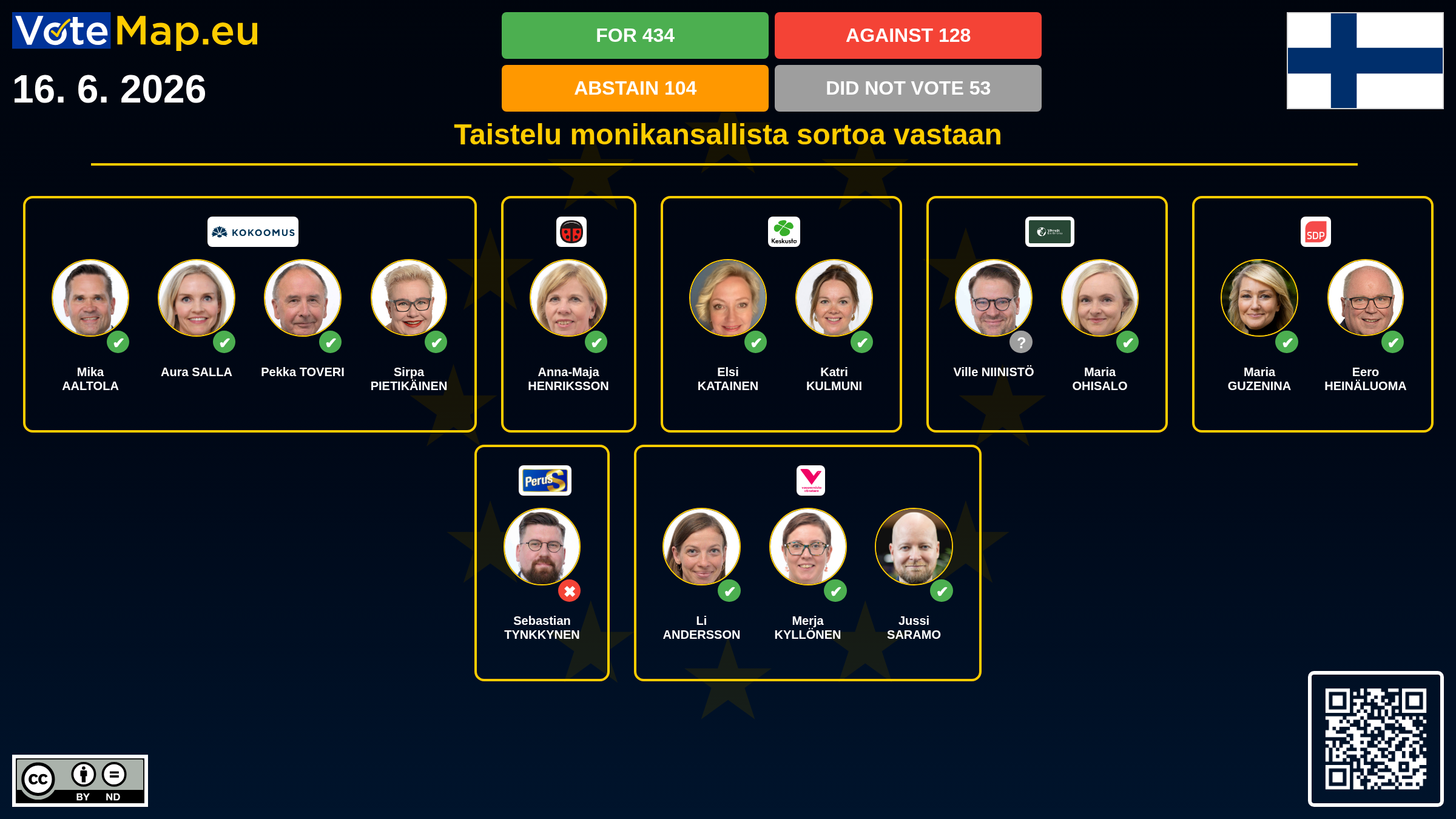
Transnational repression means that a state reaches beyond its borders to target people living abroad – dissidents, journalists, activists or members of the diaspora – and their families. The resolution defines it as deliberate acts or threats by states, including authoritarian regimes, entities affiliated with them and their proxies, aimed at intimidating, silencing, controlling or otherwise harming these people. The text refers to research by Freedom House: transnational repression is estimated to threaten 3.5 million people; cases have been documented in more than 100 countries; and between 2014 and 2025, the organisation recorded 1,375 direct physical incidents in 107 countries.
The resolution names Russia, China, Iran and Belarus as the main perpetrators in Europe and worldwide. According to the text, Russia is among the most aggressive perpetrators in the world and is responsible for the highest number of documented incidents in the EU of any country of origin. It resorts to murder, attempted murder, kidnapping and blackmail, threatens even EU lawmakers, and utilises proxy forces, including the Wagner Group and Chechen ‘death squads’. Belarus carries out repression on an alarming scale, including within the EU, and abuses Interpol’s red notice system to target political opponents in exile. According to the resolution, China is responsible for the most comprehensive and systematic campaign of transnational repression in the world. Reports from human rights defenders cited in the text suggest that it operates secret police stations on European soil without any legal basis. Iran has long been persecuting people abroad whom it regards as opponents and carries out repressive actions within the EU. These operations are directed at the highest levels of state power and are carried out by the Ministry of Intelligence and the Islamic Revolutionary Guard Corps. Planned assassinations and abductions of opposition figures have been documented on European soil.
The resolution calls on the Commission and the European External Action Service, together with Europol, to establish an EU mechanism for data collection, monitoring and reporting on transnational repression. The Council is to appoint a coordinator to combat such repression. The Commission is to introduce an EU appeal mechanism against the misuse of Interpol red notices. Member States are to review and, where appropriate, revoke ‘golden visas’ granted to individuals linked to regimes that engage in repression. Perpetrators are to be systematically assessed for inclusion on the EU’s global human rights sanctions list.
The report was prepared in the Committee on Foreign Affairs by rapporteur Hannah Neumann (Greens/EFA). In a press release from her group, she stated: “Authoritarian regimes no longer seek to silence critics only at home. They track them down, threaten them and attack them here in Europe, often in collusion with organised crime.” (translated from English)
The report was adopted by 434 votes in favour, 128 against and 104 abstentions. The EPP (169 in favour, 1 abstention), S&D (126 in favour), Renew (68 in favour) and Greens/EFA (46 in favour, 2 abstentions) supported it by an overwhelming majority; the pro-European majority was united.
PfE (73 against, 6 abstentions) and ESN (25 against) voted against it. The ECR largely abstained: 58 of its MEPs abstained, 11 voted against and 8 in favour. The far right was therefore not unanimously opposed. The Left, that is, the far left, also largely abstained: 31 abstentions, 13 votes in favour and none against.
We collect and visually present data publicly available at the page of European Parliament. Votemap.eu denies any responsibility for possible inconsistencies of the data or its changes after the publication.
Descriptions are created using DeepL Translate machine translation. We apologize for any possible imperfections or inconvenience.