Rules governing European political parties and foundations
2026-06-16
The resolution on the application of the recast Regulation on European political parties and foundations was adopted: 426 MEPs voted in favour, 140 against and 107 abstained. It was supported by the EPP, S&D, Renew and Greens/EFA – that is, all four groups of the pro-European majority. The PfE and ESN voted against, whilst the ECR largely abstained, as did the majority of The Left. The text calls on the Commission to put forward a legislative proposal to revise the rules on the funding of European political foundations.
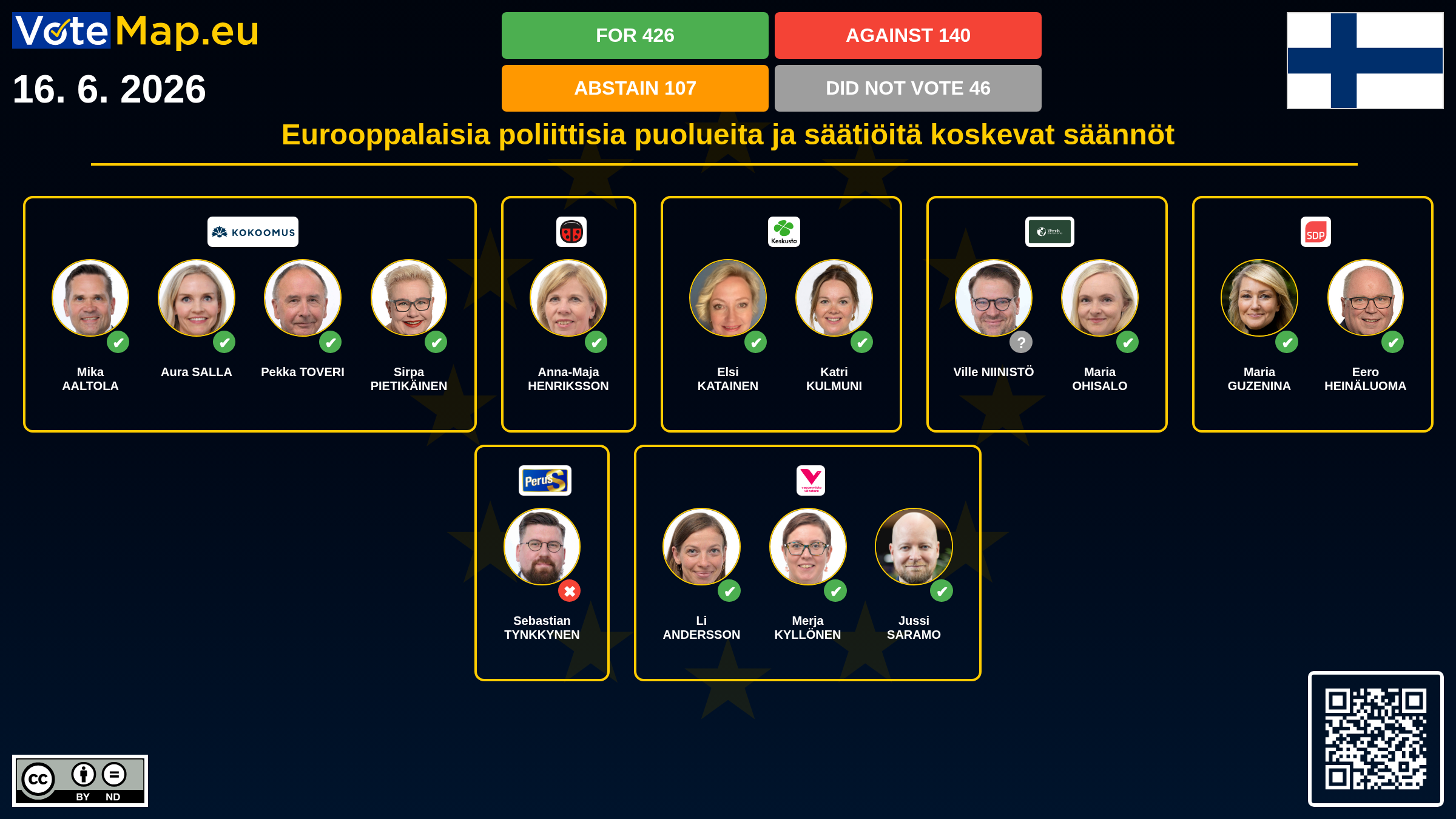
European political parties work in partnership with their national member parties, and each has an associated European political foundation. In accordance with the foundations’ statutes, they promote political debate, research, education and citizen engagement at both European and national levels. Their services are to be open to all on equal terms, not just to members or voters of a single party. As at 31 December 2025, 12 European political parties and 12 associated foundations were funded from the EU budget.
The status and funding of both are governed by the recast Regulation (EU, Euratom) 2025/2445, which has been in force since 28 December 2025. The Regulation requires the European Parliament to publish a report by 29 June 2026 on how it is being implemented. The Commission then has one year to produce its own report, accompanied by proposals for amendments where appropriate. This report was drawn up by the Committee on Constitutional Affairs (AFCO), with Loránt Vincze (EPP) and Charles Goerens (Renew) acting as rapporteurs. It is a non-legislative resolution, not a law. It was not debated separately in plenary.
The resolution welcomes the adoption of the regulation and notes that it has improved legal clarity, including with regard to safeguards against foreign interference. At the same time, it points out that there is as yet little experience with the new rules. According to the text, unforeseen problems arose immediately after the regulation came into force, particularly regarding the funding of political foundations, and these require urgent measures. Foundations report a disproportionate administrative burden. The resolution notes this with concern and promises to investigate the matter.
The specific demands relate to funding. The resolution calls on the Commission to submit a legislative proposal to revise the rules on the funding of foundations. According to the resolution, a grant from the EU budget should be allowed to cover up to 100 per cent of a foundation’s eligible costs. The ceiling on donations, which currently stands at €18,000 per year from a single donor, should also be raised. The Commission is also to examine whether national rules prevent national entities from making contributions to European foundations. The text further proposes a single online system for reporting and publishing EU funding, donations and contributions to foundations. It also includes a commitment to increase the total EU funding for foundations under the multiannual financial framework for 2028–2034. It justifies this on the grounds that the budget has not been index-linked in recent years, whilst inflation and operating costs have risen.
Result: 426 in favour, 140 against, 107 abstentions. The EPP, S&D, Renew and Greens/EFA voted overwhelmingly in favour. Within the EPP, there were 166 votes in favour, 2 against and 2 abstentions; within the S&D, 131 in favour and 1 against; within Renew, 68 in favour; and within the Greens/EFA, 48 in favour. The resolution was passed by a pro-European majority. The EPP and the far right did not take part in the vote.
The far right was not united. PfE (79 against) and ESN (25 against) were opposed as a whole. The ECR largely abstained: 60 of its MEPs abstained, 16 voted against and 2 in favour. The Left, i.e. the far left, mostly abstained (36 abstentions, 7 in favour, 1 against).
We collect and visually present data publicly available at the page of European Parliament. Votemap.eu denies any responsibility for possible inconsistencies of the data or its changes after the publication.
Descriptions are created using DeepL Translate machine translation. We apologize for any possible imperfections or inconvenience.