The European Semester: employment and social priorities
2026-03-11
The resolution on the social and employment priorities of the European Semester was adopted by 404 votes in favour and 208 against, with 20 MEPs abstaining. It was supported by all four groups of the pro-European majority – the EPP, S&D, Renew and Greens/EFA – though Renew was the least united in its support. The ECR, PfE and ESN voted against it, with not a single vote in favour. The text, drafted by rapporteur Nela Riehl (Greens/EFA), welcomes the announced strategy to combat poverty and the plan for affordable housing.
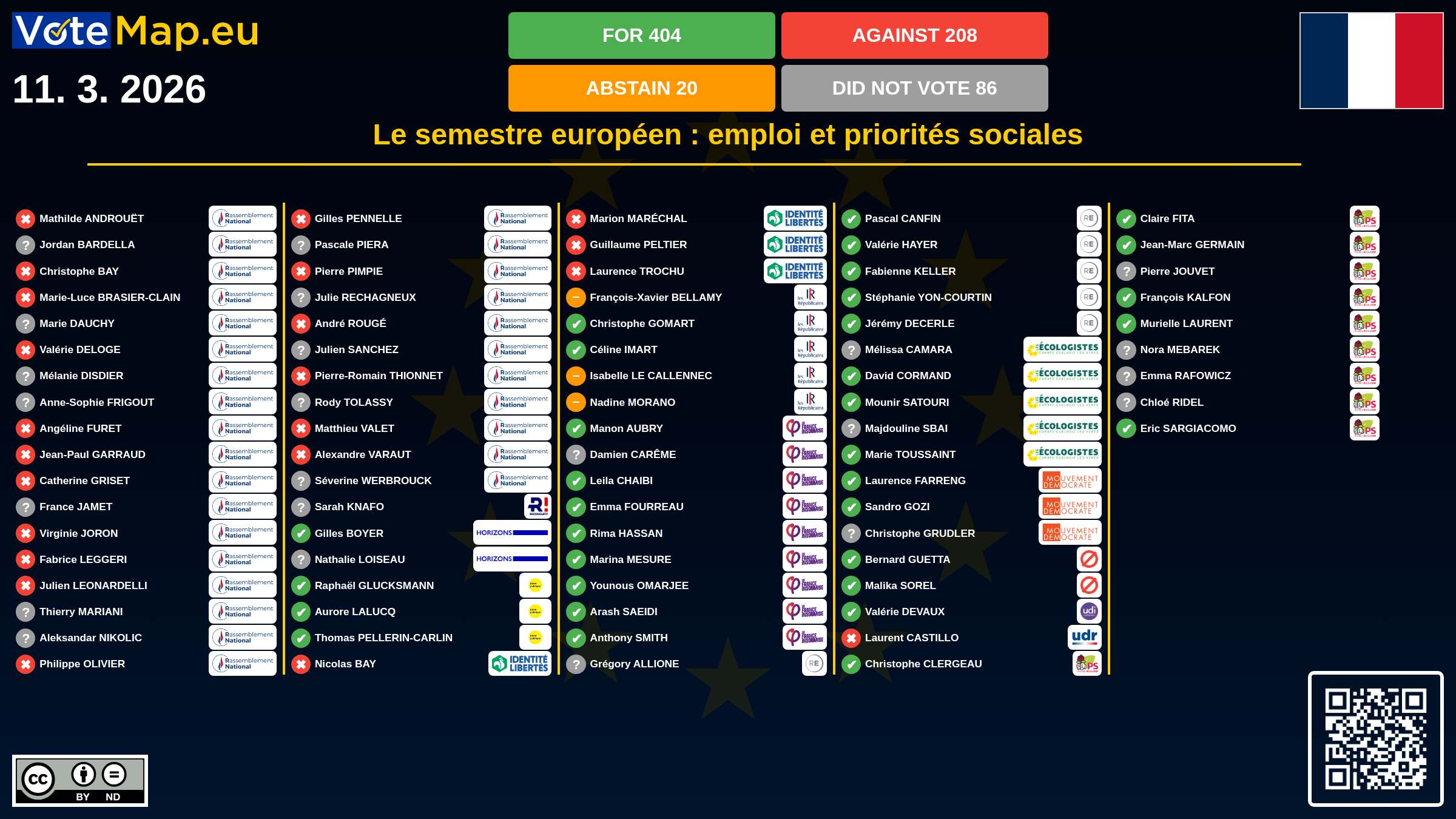
The European Semester is an annual cycle during which the European Union coordinates the economic policies of the Member States. One of its outcomes is a set of country-specific recommendations. The European Parliament issued two own-initiative reports on the 2026 European Semester: one was drawn up by the ECON Committee, and the other by the Committee on Employment and Social Affairs (EMPL). This vote concerned the latter, report A10-0033/2026, for which Nela Riehl (Greens/EFA) was the rapporteur. It is a non-legislative resolution – it does not in itself bring about any changes, but summarises the social priorities that, according to the majority of MEPs, the Semester should pursue.
The resolution bases its demands on data. It recalls the target of 78 per cent employment by 2030 and states that in October 2025, unemployment in the EU stood at 6 per cent and at 13.2 per cent amongst young people. In 2024, 93.3 million people – 21 per cent of the EU’s population – were at risk of poverty or social exclusion. Among children, the figure was 19.5 million, or 24.2 per cent of the total. As many as 8.2 per cent of workers also live in poverty. The text states that the gender pay gap stands at 12 per cent, whilst the gender pension gap is 25 per cent.
The text addresses minimum wages and in-work poverty, housing and energy poverty, deinstitutionalisation – that is, the move away from institutional care for people with disabilities – investment in skills and education, and intergenerational justice. It welcomes the announced EU strategy to combat poverty, the plan for affordable housing and the forthcoming legislation on quality jobs. With regard to the European Semester itself, it calls for a more transparent methodology for country-specific recommendations and the full involvement of the Parliament and the social partners.
The resolution was adopted by 404 votes to 208, with 20 MEPs abstaining. It was backed by all four groups of the pro-European majority, which had also negotiated it: alongside the rapporteur from the Greens/EFA, the shadow rapporteurs were from the EPP (Angelika Winzig), the S&D (Idoia Mendia) and Renew (Hristo Petrov). We were unable to find any statements from any of them regarding the vote; we therefore describe their positions based on how they voted.
The S&D voted unanimously in favour (120 in favour, none against and no abstentions). Greens/EFA, which provided the rapporteur, supported the text almost unanimously (46 in favour, 1 against). The EPP voted predominantly in favour (144 in favour, 12 against, 8 abstentions). Renew was the least united: 49 of its MEPs voted in favour, 15 against and 4 abstained. Support therefore clearly prevailed within this group as well, but it had the highest number of votes against of all four groups.
The entire far right opposed the resolution. Neither the ECR (75 against) nor the PfE (62 against) cast a single vote in favour of the resolution; the ESN voted 22 against, with 2 of its MEPs abstaining. The Left, the far-left group, voted overwhelmingly in favour (32 in favour, 7 against, 4 abstentions).
On the same day, the plenary also adopted a second report on the 2026 semester, prepared by Kira Marie Peter-Hansen (Greens/EFA) on behalf of the ECON Committee, which focuses on its economic and fiscal aspects.
We collect and visually present data publicly available at the page of European Parliament. Votemap.eu denies any responsibility for possible inconsistencies of the data or its changes after the publication.
Descriptions are created using DeepL Translate machine translation. We apologize for any possible imperfections or inconvenience.