The 2024 EU budget: discharge and a postponement for the Council
2026-04-29
Parliament granted discharge for the 2024 EU budget to the Commission, itself, the Court of Auditors, the EEAS, the EESC and the European Public Prosecutor’s Office. It deferred the decision on the Council because it refuses to cooperate with it; the resolution on the Council was adopted by 432 votes to 160, with 65 abstentions. The EPP, S&D, Renew and Greens/EFA – that is, the pro-European majority – were divided only on the resolution concerning the Court of Auditors, where the EPP voted alongside the ECR. The paragraph on EU funding for non-governmental organisations in Gaza was included thanks to the votes of the ECR and PfE.
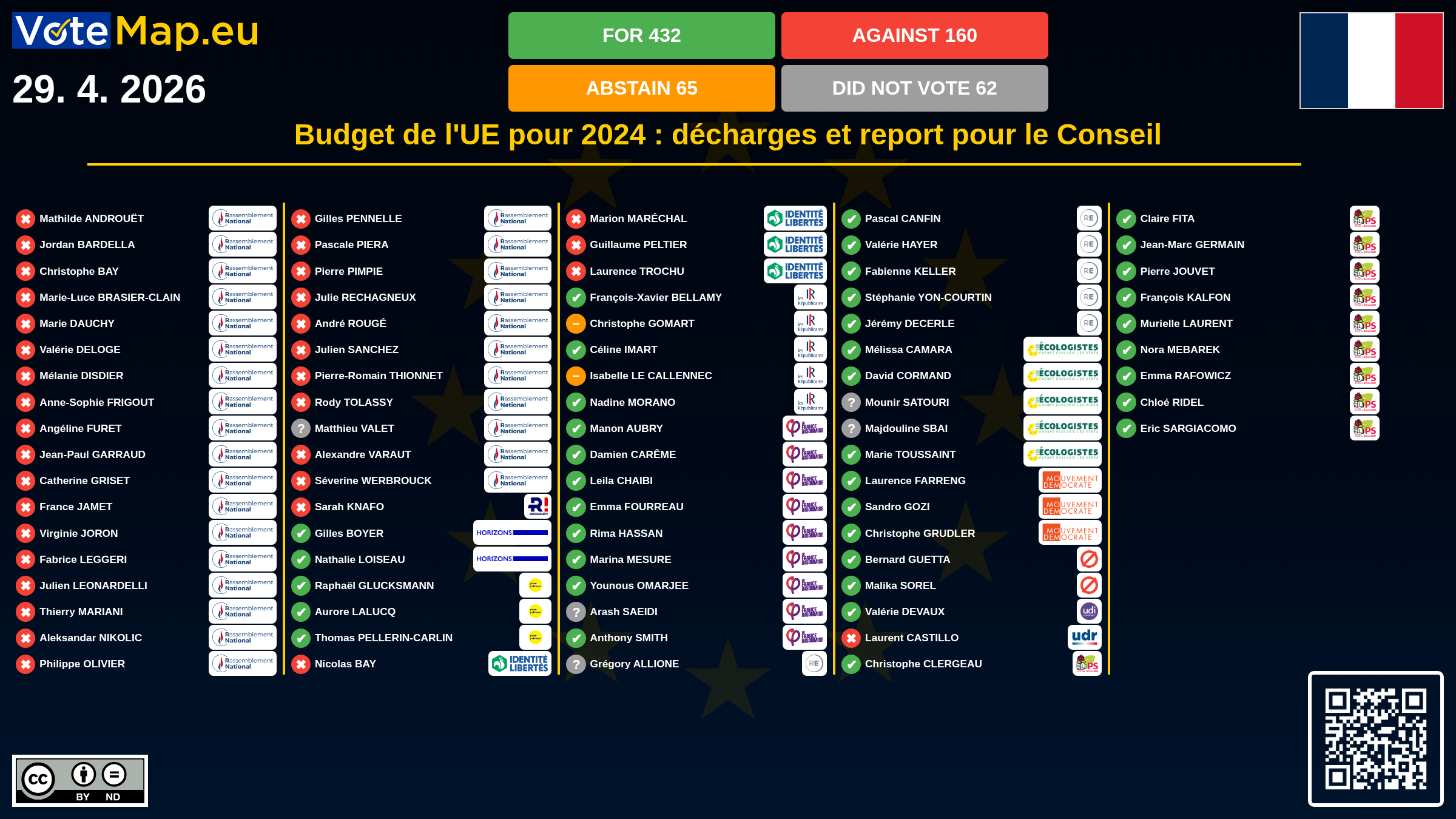
Each year, Parliament concludes its audit of the financial management of the EU institutions by granting discharge. There are two votes: one on whether to grant or postpone discharge, and one on a resolution containing observations. With the exception of the Commission, the decision was taken by a show of hands without a recorded vote; the figures below therefore relate to the resolutions, unless otherwise stated.
Discharge was granted to the Commission, the Parliament, the European Court of Auditors, the European External Action Service (EEAS), the European Economic and Social Committee (EESC) and the European Public Prosecutor’s Office (EPPO). Five reports, including the one on the Council, were drafted by rapporteur Tridico of The Left (the far left); the report on the Commission by Freund (Greens/EFA) and the report on the Parliament by Gerbrandy (Renew).
The EPP, S&D, Renew and Greens/EFA – that is, the pro-European majority – voted almost unanimously in favour of six out of the seven resolutions, with The Left generally supporting them as well. None of the four groups expressed a separate opinion on the discharge motions. Of the ECR, PfE and ESN – that is, the far right – the PfE and ESN voted against these six resolutions. The ECR voted against the Commission, the EESC and the EPPO, but mostly abstained on the EEAS (67 out of 80) and Parliament (69 out of 81). The resolutions were adopted with the following votes in favour : against : abstentions: Commission 418 : 207 : 14, Parliament 441 : 131 : 81, EEAS 429 : 145 : 76, EESC 478 : 146 : 27, EPPO 454 : 161 : 29.
Parliament has deferred granting discharge to the European Council and the Council for the financial year 2024. The resolution on this matter was adopted by 432 votes to 160, with 65 abstentions. It notes that the Council continues to refuse to cooperate with Parliament in the scrutiny of its budget, and that Parliament has therefore repeatedly refused to grant it discharge since 2009, most recently for the financial year 2023. On 3 October 2025, the Council Secretariat announced once again that it would not respond to Parliament’s questionnaire and would not attend the hearing on 6 November 2025. The EPP (150 in favour, 13 abstentions), S&D, Renew, Greens/EFA and The Left voted in favour, whilst PfE and ESN were unanimously against. The ECR was divided: 46 MEPs abstained, 32 were against and 3 in favour.
The vote on the Commission’s discharge was held electronically, but without a roll-call record: the motion was passed by a vote of 389 to 255, with 3 abstentions. The resolution on the Commission focuses on the rule of law. It criticises Hungary for persistent problems within the judiciary and the media, and refers to Parliament’s action before the Court of Justice against the Commission’s decision of 13 December 2023 to release suspended funds. With regard to Slovakia, it notes with concern that, in the second half of 2024, the country abolished its specialised anti-corruption units, the National Criminal Agency and the Office of the Special Prosecutor. Due to the lack of data on the final beneficiaries of funds from the Recovery and Resilience Facility, the resolution calls on the Commission to initiate proceedings against Member States; should it fail to do so, Parliament will consider all measures, including legal action.
The only split within the pro-European majority came on the resolution on the European Court of Auditors (343 : 160 : 150). The EPP and Renew voted unanimously in favour, the S&D against (115 out of 124) and the Greens/EFA abstained (38 out of 45), as did The Left. The EPP voted alongside the ECR, of whom 52 MEPs voted in favour and 27 abstained; PfE was divided and the ESN voted against. The resolution would have passed even without the votes of the ECR and PfE.
Paragraph 78, inserted by an amendment, was contentious. It calls on the Court of Auditors to produce a special report on EU funds for non-governmental organisations operating in connection with Gaza and for organisations involved in the production of Palestinian textbooks, to ensure that EU funds are not diverted, even indirectly, to terrorist organisations. This part of the amendment was adopted by 350 to 269, with 24 abstentions, thanks to the votes of the ECR (81) and PfE (71): the EPP (162) voted in favour, as did these two far-right groups; without them, the amendment would not have passed. The ESN largely abstained. The S&D, Greens/EFA, Renew and The Left voted against. The groups did not explain in the available sources why the S&D rejected the entire resolution and why the Greens/EFA abstained.
We collect and visually present data publicly available at the page of European Parliament. Votemap.eu denies any responsibility for possible inconsistencies of the data or its changes after the publication.
Descriptions are created using DeepL Translate machine translation. We apologize for any possible imperfections or inconvenience.