Wastewater treatment and access to medicines
2026-06-18
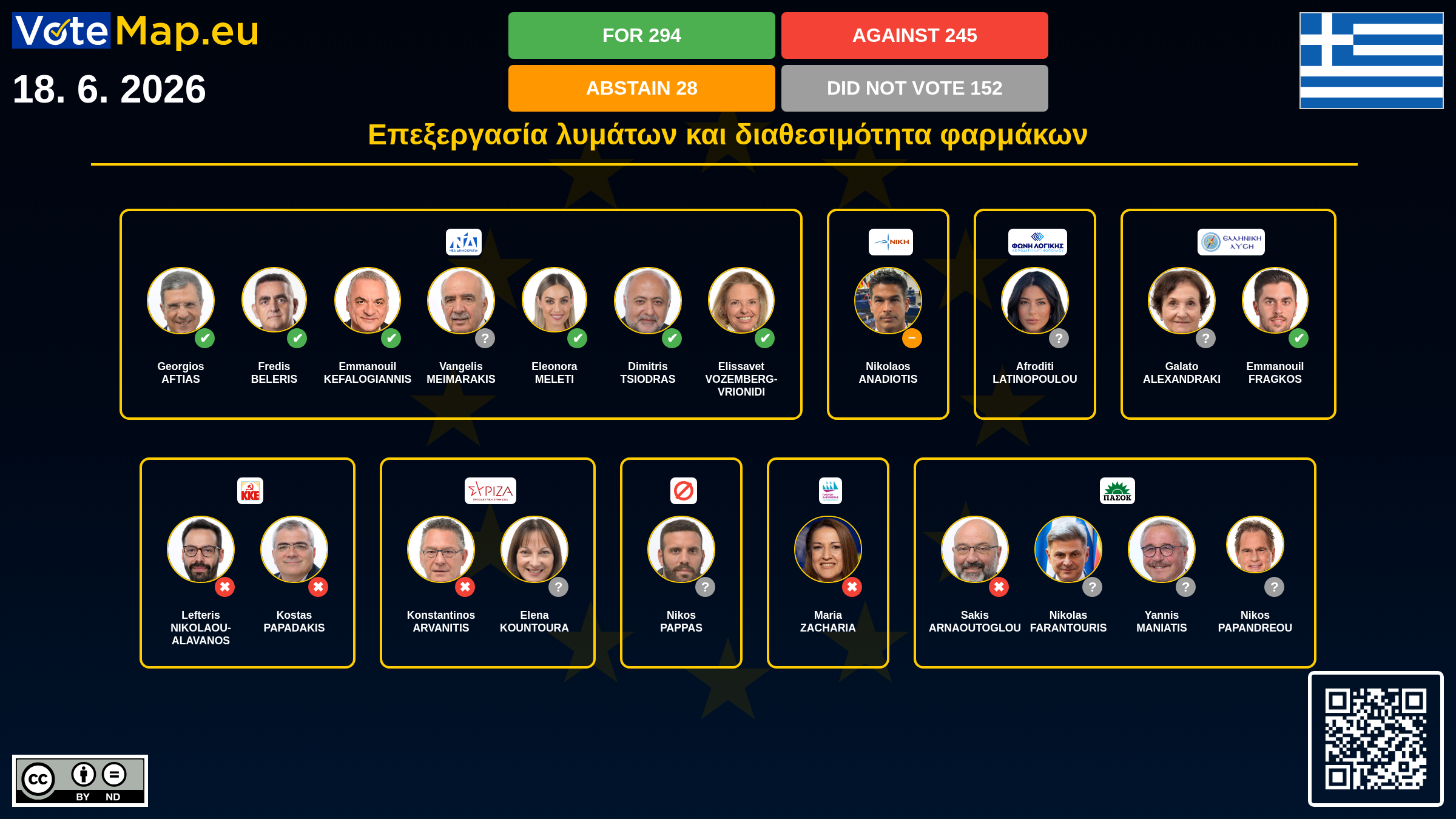
The resolution on the implementation of the Urban Waste Water Treatment Directive calls for a temporary suspension of the requirement for tertiary treatment and of the levies intended to finance it, to be paid by manufacturers of medicines and cosmetics, pending the completion of a new study. It was adopted by 294 votes to 245, with 28 abstentions, thanks to the votes of the ECR, PfE and ESN groups, alongside which the EPP voted. The S&D, Renew and Greens/EFA groups, which had drafted the original proposal together with The Left, ultimately voted against it.
The revised Urban Waste Water Treatment Directive came into force on 1 January 2025. It requires large treatment works to introduce tertiary treatment, an additional stage that removes micropollutants from the water. According to the Commission and the Joint Research Centre, the largest proportion of these micropollutants comes from medicines and cosmetics. The obligation will be phased in gradually from December 2033 to December 2045 and, in accordance with the ‘polluter pays’ principle, at least 80 per cent of the costs are to be borne by the pharmaceutical and cosmetics industries (known as extended producer responsibility). However, Germany and Spain have estimated the costs to be several times higher than the Commission’s figures.
The resolution calls on the Commission to draw up a new impact assessment by the end of 2026 to verify the costs, the distribution of responsibility across sectors and the impact on the availability of medicines, and to inform Member States by the end of July 2026 about the flexibility offered by the Directive. In paragraph 9, it then calls for a temporary suspension (‘stop the clock’) of the provisions on extended producer responsibility, quaternary treatment obligations and related financial liabilities until the study is complete and the Commission has assessed its conclusions. It does not call for the repeal of the Directive: in paragraph 1, it reiterates its strong support for its implementation ‘in accordance with the set deadlines’ and describes extended producer responsibility as the most effective instrument for the ‘polluter pays’ principle.
The motion was prompted by an oral question put to the Commission by Oliver Schenk, Peter Liese and Tomislav Sokol on behalf of the EPP. This was followed by nine motions for resolutions from eight political groups. The vote was based on a joint motion signed by Vlad Vasile-Voiculescu (Renew), Alessandra Moretti (S&D), Jutta Paulus (Greens/EFA) and Per Clausen (The Left); the EPP was not among the signatories. Ten amendments were voted on first; nine were adopted with the support of the EPP, ECR, PfE and ESN. These amendments shifted the text towards a request for a deferral of obligations.
The resolution as a whole was then adopted by 294 votes in favour, 245 against and 28 abstentions. The EPP voted in favour (135 in favour, 1 against, 4 abstentions), together with the ECR (54 in favour), PfE (51 in favour) and ESN (19 in favour). Without the votes of the ECR, PfE and ESN, the vote would have stood at 170 in favour against 231; the resolution therefore passed thanks to votes from the far right. Three of the four groups in the pro-European majority voted against the text, the original version of which they themselves had signed: the S&D (5 in favour, 100 against), Greens/EFA unanimously (43 against) and, by a majority, Renew (13 in favour, 45 against, 3 abstentions). The Left (38 votes), i.e. the far left, also voted unanimously against.
The division was already evident during the debate on 25 March 2026. Peter Liese (EPP) proposed: “Let’s give ourselves some time first – a one-year extension.” Alessandra Moretti (S&D) regretted that, on such an important and sensitive issue, the EPP had “chosen once again to align itself with far-right parties”. Jutta Paulus (Greens/EFA) criticised those in favour of a postponement, saying that instead of upholding the ‘polluter pays’ principle, they were ‘siding with the pharmaceutical and cosmetics industries’. Vlad Vasile-Voiculescu (Renew) emphasised that a sustainable and fair policy can only be achieved through “a balance […] between environmental protection and access to medicines”. The quotations have been translated from German, Italian and Romanian.
We collect and visually present data publicly available at the page of European Parliament. Votemap.eu denies any responsibility for possible inconsistencies of the data or its changes after the publication.
Descriptions are created using DeepL Translate machine translation. We apologize for any possible imperfections or inconvenience.