Regime 28: tax rules for businesses across the EU
2026-07-09
The resolution on the tax component of the so-called ‘28th regime’ – that is, voluntary pan-European rules for businesses alongside the 27 national systems – was adopted by 366 votes in favour, 192 against and 39 abstentions. It was supported by the EPP, S&D, Renew and Greens/EFA – in other words, the pro-European majority. The ECR, PfE and ESN – the far right – voted against it. The Left, representing the far left, was divided. The rapporteur was Ľudovít Ódor (Renew).
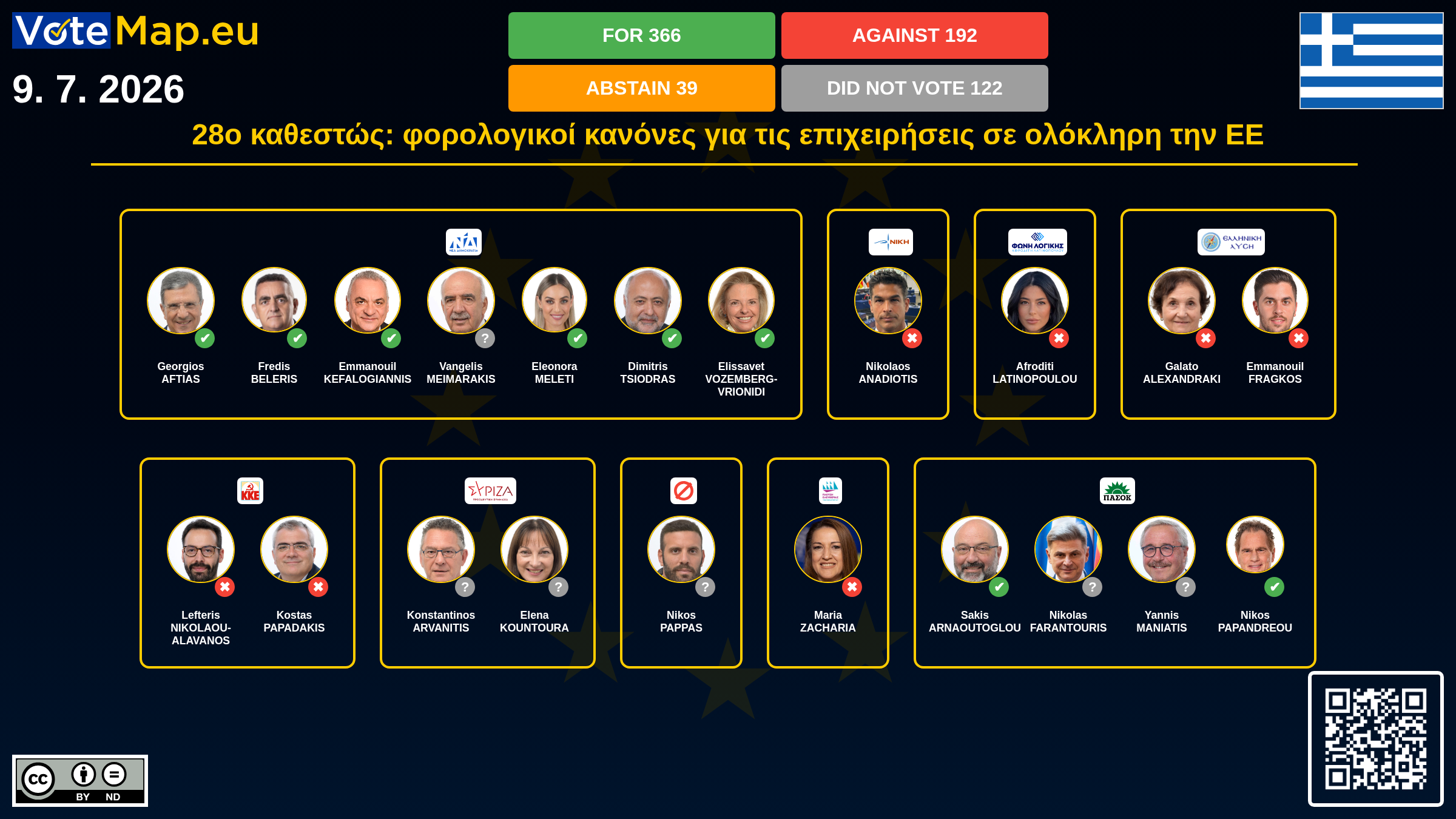
‘The 28th regime’ is the term used to describe voluntary pan-European rules for businesses. A company wishing to operate in several EU Member States currently faces 27 different national systems; under the 28th regime, it would be able to choose a single set of rules applicable across the entire Union. On 18 March 2026, the Commission presented a proposal for the ‘EU Inc.’ Regulation, which introduces this framework for company law.
The resolution cites as its rationale the fact that, in 2025, Europe had only 331 so-called ‘unicorns’ amongst its start-ups, compared with 1,963 in the United States.
The resolution was drafted by the Committee on Economic and Monetary Affairs (ECON), with Ľudovít Ódor (Renew) acting as rapporteur. This is not a vote on the regulation itself, but an own-initiative resolution examining how to introduce taxes under the 28th regime. It welcomes the Commission’s proposal but calls for it to be ambitious on tax issues as well, and recommends a modular approach: first company law, then the so-called tax module.
Companies participating in the tax module should have a single, consolidated corporate tax base across the EU, allocated amongst Member States according to a formula that takes into account turnover, labour and tangible assets. Member States would continue to set their own tax rates. With regard to VAT, the text calls for a single EU VAT number and a common digital portal, rather than the harmonisation of rates. Employee share options should be mandatory under the tax module. Initially, the module should apply only to certain types of companies, such as cross-border start-ups and fast-growing enterprises.
According to the resolution, the 28th regime must not allow the circumvention of protections for workers and trade unions, and only companies carrying out genuine economic activity in the EU should have access to the tax module. The module must not lead to the creation of letterbox companies nor become a tool for ‘tax shopping’, i.e. the search for the lowest tax rates. As the EU Council decides on tax matters by unanimity, the resolution considers a transition to qualified majority voting necessary in certain areas, such as administrative procedures.
The EPP, S&D, Renew and Greens/EFA – that is, the pro-European majority – voted in favour; however, their speakers placed varying emphasis on different points during the debate. Rapporteur Ódor welcomed the Commission’s proposal, but argued that it “is not ambitious enough, as it focuses primarily on company law”. Luděk Niedermayer (EPP) called on both Parliament and the Council not to water down the proposal: “Strengthen it and adopt it swiftly.” René Repasi (S&D) said that “EU Inc. must become a seal of quality, not yet another tool for dumping”. Kira Marie Peter-Hansen (Greens/EFA) warned that Europe’s competitiveness “cannot be built on tax avoidance, lower standards or a race to the bottom”. The quotations have been translated; Repasi’s from German, the others from English.
By group: EPP 149 in favour, 4 against, 7 abstentions; S&D 98 in favour, 1 against, 8 abstentions; Renew 63 in favour, 4 against; Greens/EFA 41 in favour, 1 against, 3 abstentions. The ECR, PfE and ESN – that is, the far right – voted against, and none of them voted in favour: ECR 62 against and 2 abstentions; PfE 63 against and 5 abstentions; ESN 24 against and 1 abstention. The EPP did not vote alongside the far right on this issue. The Left, i.e. the far left, was divided: 12 in favour, 19 against, 5 abstentions.
We collect and visually present data publicly available at the page of European Parliament. Votemap.eu denies any responsibility for possible inconsistencies of the data or its changes after the publication.
Descriptions are created using DeepL Translate machine translation. We apologize for any possible imperfections or inconvenience.