Objection to the renewal of the authorisation for GM soya MON 87769
2026-10-21
The objection to the renewal of the authorisation for genetically modified MON 87769 soya was passed by a vote of 442 to 196, with 9 abstentions. The S&D and Greens/EFA groups supported it by an overwhelming majority, the EPP voted against it by a large majority, and Renew was split almost down the middle. This is the thirty-first objection to the authorisation of a GMO during this parliamentary term, and they have all ended in the same way: they have been passed, and the pro-European majority has been similarly divided on each occasion. The resolution is non-binding, and the Commission continues to authorise GMOs.
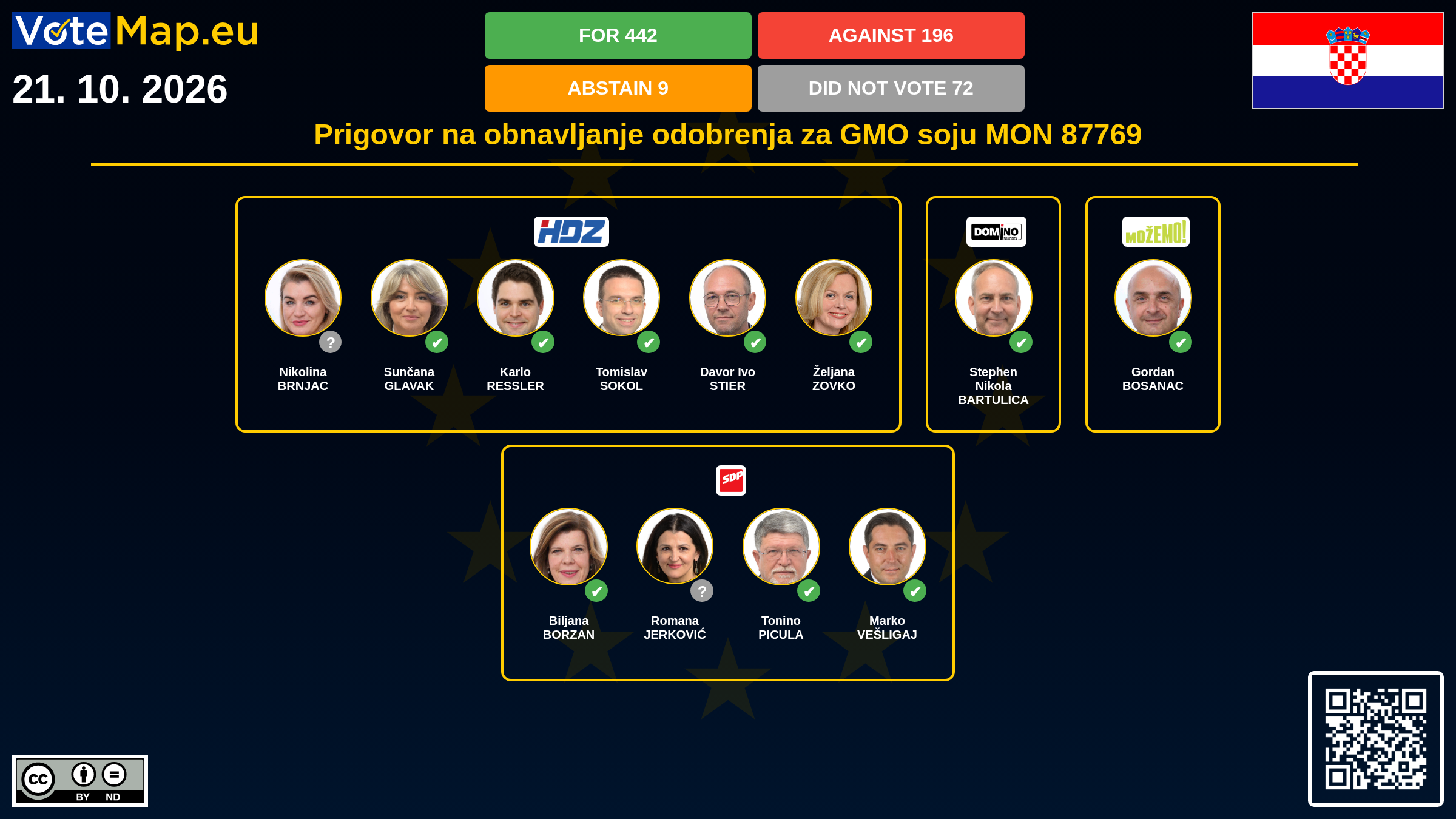
The motion for a resolution was tabled by the ENVI Committee, and is listed as having been tabled by Sirpa Pietikäinen (EPP), Biljana Borzan (S&D), Martin Häusling (Greens/EFA) and Anja Hazekamp (The Left). They object to the Commission’s proposal to renew the authorisation for MON 87769 soya, which has been modified so that its oil has a different fatty acid composition – more stearidonic acid, gamma-linolenic acid and two trans-fatty acids, and less linoleic acid. The 2015 authorisation covers food and feed, not cultivation within the EU.
The text of the objection states that the proposal exceeds the Commission’s implementing powers and runs counter to the objective of the GMO Regulation, namely a high level of protection for human and animal health and consumer interests in accordance with the precautionary principle. According to the objection, the EFSA’s assessment of 19 January 2026 was based on the assumption that the DNA is identical to the line originally assessed, the original assessment is over ten years old, and the comparison used statistics from the 2006 guidance rather than the 2011 method. Furthermore, the authorisation holder stated that no such soya or edible oil had been imported into the EU during the entire period in question, meaning that the exposure assumptions could not be verified. The resolution calls on the Commission to withdraw the proposal, not to renew the authorisation, and to propose a reform of the decision-making process on GMOs.
The motion was passed by 442 votes in favour, 196 against and 9 abstentions. The pro-European majority was divided. The S&D Group supported it by an overwhelming majority (108 in favour, 12 against, 2 abstentions), as did the Greens/EFA (40:4:2). The EPP was largely opposed, 43:118:1. Renew was split almost exactly down the middle, 38:35:1.
Of the other groups, The Left (42:0) and ESN (24:0) supported the objection unanimously, as did, for the most part, the ECR (60:13:1) and PfE (65:13). The far right thus voted against the majority of the EPP. Their votes did not decide the outcome: without the votes of the ECR, PfE and ESN, the objection would have passed by a margin of 293 to 170.
Such voting is not an exception. Since November 2024, Votemap has recorded 31 roll-call votes on objections to GMO authorisations, and all have been passed, with between 373 and 496 votes in favour. The pattern is consistent: the EPP has been against by a majority on every occasion, whilst the S&D and Greens/EFA have been in favour by a significant majority every time. Renew was split in 30 out of 31 cases; the exception was the objection to COT102 cotton in November 2024, which it supported by a vote of 55:13:1. The ECR, PfE, ESN and The Left voted in favour by a majority in all 31 cases.
However, the objection is not binding on the Commission. It is an objection to an implementing act, not to a delegated act, so the resolution merely calls on the Commission, which may proceed. Representatives of the Member States vote on authorisation beforehand; in the case of MON 87769 soya, no opinion was reached either in the Standing Committee (9 September 2026) or in the Appeal Committee (20 October 2026). The resolution recalls that previous Parliament resolutions have repeatedly called on the Commission not to authorise GMOs without a qualified majority of Member States, and notes that the Commission continues to authorise them nonetheless.
We collect and visually present data publicly available at the page of European Parliament. Votemap.eu denies any responsibility for possible inconsistencies of the data or its changes after the publication.
Descriptions are created using DeepL Translate machine translation. We apologize for any possible imperfections or inconvenience.