The rule of law and the misuse of EU funds in Slovakia
2026-05-20
The resolution on the rule of law, fundamental rights and the misuse of EU funds in Slovakia was adopted by 347 votes in favour, 165 against and 25 abstentions. It was tabled by the EPP, S&D, Renew and Greens/EFA – that is, the entire pro-European majority – together with The Left; all four groups also voted in favour of it. The PfE, ESN and the majority of the ECR voted against it. The resolution calls on the Commission to assess whether there is a clear risk that Slovakia will seriously breach EU values, and to make full use of all available instruments.
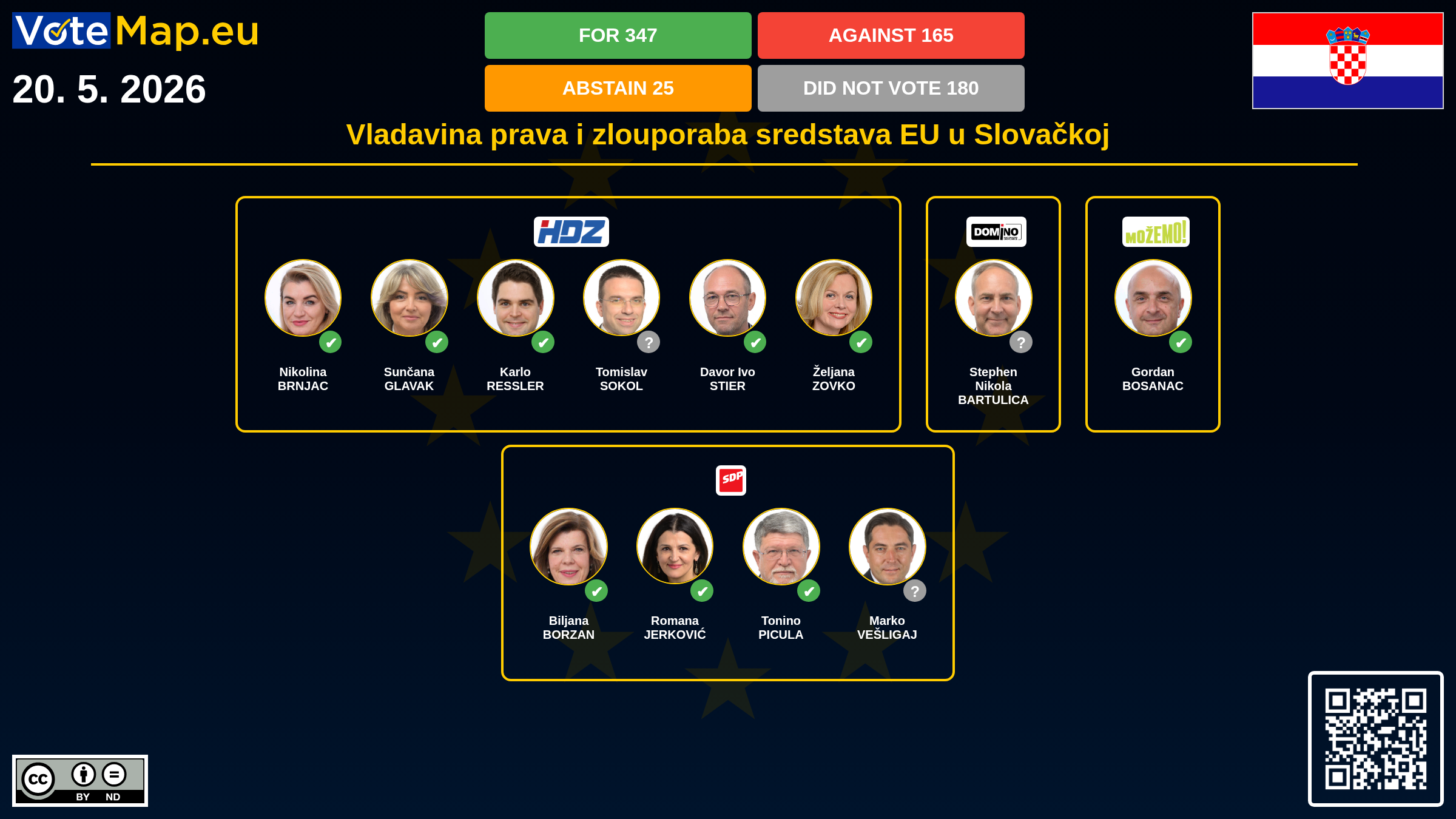
347 MEPs voted in favour of the resolution, 165 voted against and 25 abstained. All four groups of the pro-European majority supported it: S&D (106), Renew (57) and Greens/EFA (37), with not a single vote against or abstention; the EPP had 114 votes in favour, with 3 against and 4 abstentions. The Left voted predominantly in favour (27 in favour, 1 against, 10 abstentions). Of the far-right groups, PfE voted unanimously against (70), ESN had 23 votes against and 1 abstention, and ECR had 53 against, 4 in favour and 6 abstentions. The result was carried by the pro-European majority; the EPP and the far right did not take part in the vote.
The resolution concludes the debate on the Council and Commission statements on Slovakia of 11 February 2026. The text was jointly tabled by the EPP, S&D, Renew and Greens/EFA, and was also co-signed by The Left. The pro-European majority’s stance is evidenced by the fact that this is its own motion, which it also voted in favour of.
The resolution “expresses deep concern at the deterioration of democracy, the rule of law and fundamental rights in Slovakia” and points out that verifiable compliance with the rule of law and the Charter of Fundamental Rights is a fundamental condition for receiving any EU funding. It calls on the Commission to assess whether there is a clear risk that Slovakia will seriously breach the values set out in Article 2 of the Treaty on European Union. If these concerns persist and are duly substantiated, the Commission should not hesitate to impose enforcement measures, including infringement proceedings and the suspension of payments. The resolution also reiterates the call to initiate the first step of the procedure under the Regulation on conditionality regarding respect for the rule of law.
A large part of the text concerns the fight against corruption. According to a mission by the monitoring group of the Committee on Civil Liberties, the fight against corruption is no longer a priority for the Slovak Government. The resolution expresses regret that Slovakia has reduced penalties for corruption and financial crimes, shortened limitation periods, and abolished the National Criminal Agency and the Office of the Special Prosecutor. It ‘strongly condemns’ the abolition of the Special Prosecutor’s Office: according to the text, its impact on the prosecution of corruption cannot be offset by the work of the European Public Prosecutor’s Office (EPPO). The Office previously investigated between 120 and 150 cases a year. In the first few months of 2025, preliminary statistics suggest that only two indictments were reportedly issued for similar offences. The resolution also expresses concern over the alleged misuse of rural development funds for the construction or renovation of luxury private properties.
The resolution also expresses deep concern over amendments to the Constitution of the Slovak Republic, particularly those that restrict fundamental rights, the rule of law and the primacy of EU law. It also expresses concern over the erosion of media freedom, including political interference in public service media. According to the text, the Board of Slovak Television and Radio was appointed by the government and parliament exclusively from candidates put forward by the ruling coalition. The resolution strongly condemns the growing pressure on civil society. It also calls on the Slovak authorities to protect the rights of the Roma, LGBTIQ+ people and minorities, and to put an end to land confiscations based on post-war decrees. Conversely, it welcomes the fact that, in March 2026, the Slovak Parliament repealed the controversial law that would have abolished the Office for the Protection of Whistleblowers, thereby preserving the office.
We collect and visually present data publicly available at the page of European Parliament. Votemap.eu denies any responsibility for possible inconsistencies of the data or its changes after the publication.
Descriptions are created using DeepL Translate machine translation. We apologize for any possible imperfections or inconvenience.