Soya as a high-risk feedstock for biofuels: the EPP, together with the far right, succeeded in having the Commission’s proposal rejected
2026-07-08
On 8 July 2026, Parliament, by 388 votes to 248, with 24 abstentions, adopted an objection to a Commission delegated act which classified soya, alongside palm oil, as a raw material posing a high risk of indirect land-use change. The act is thus rejected. The EPP voted in favour of the objection, alongside the ECR, PfE and ESN; the S&D, Renew and Greens/EFA voted against. The dispute centred mainly on the calculation methodology and the position of the European protein sector.
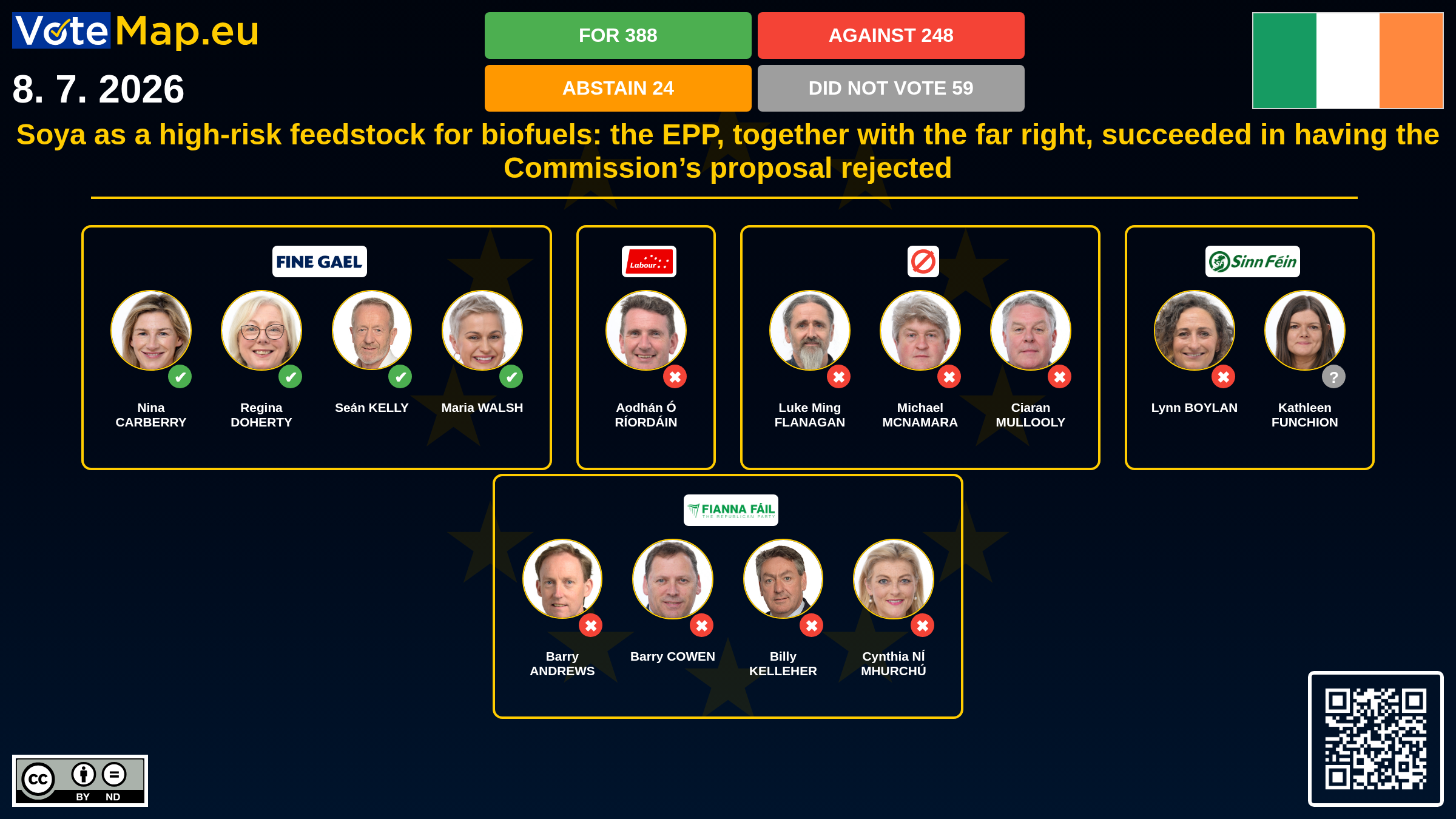
On 8 July 2026, the European Parliament adopted, by 388 votes to 248 with 24 abstentions, an objection to a Commission delegated act supplementing the Renewable Energy Directive (RED). The adoption of the objection means that the act has been rejected: it will not enter into force in its current form, and the resolution provides for the Commission to submit a revised version. Formally, this was an objection under Rule 114(3) of the Rules of Procedure.
The dispute began with a move by the Commission on 10 April 2026. The Commission was responding to a 2025 ruling by a World Trade Organisation panel and amended Regulation (EU) 2019/807: it added soya to the list of crops posing a high risk of indirect land-use change (ILUC), alongside palm oil. As a result, soya would gradually be phased out of the calculation of renewable energy targets by 2030. The resolution focuses on how the Commission arrived at this classification: it criticises the Commission for for shifting the methodology’s reference period from 2008 to 2014, for overlooking the practice of two harvests per year, and for the classification not aligning with what the Commission itself set out in the White Paper on EU protein self-sufficiency. However, the resolution does not question two parts of the act: it wants to see the restrictions on palm oil and the rectification of the certification of low-risk raw materials reinstated in the recast act.
The majority of the 388 votes was made up of the EPP together with the far right. The EPP voted in favour of the objection by 159 to 14, the ECR by 76 to 0, PfE by 72 to 0 and ESN by 24 to 0. The S&D (27 to 94), Renew (14 to 40), Greens/EFA unanimously (0:47) and The Left (0:40). The total number of votes against, broken down by group, is one vote lower than the vote tally — we were unable to identify the cause; the tally of 388 to 248 stands — and the data do not include a breakdown of the 24 abstentions by group.
There may not be a synthesis of the democratic groups’ positions here. The dispute lies between the EPP, which did not wish to retain soya on the list, and the S&D, Renew and Greens/EFA, which voted in favour of retaining it. The Greens/EFA (cohesion 1.000) and the EPP (0.919) were the most united, whilst the S&D (0.777) and Renew (0.741) voted more freely.
Prior to the vote, the Greens/EFA stated that they would vote against the objection, which they claimed right-wing groups were supporting in order to weaken European forest protection; According to the group, the EU imports 90 per cent of the soya it uses to produce biofuels, and its cultivation is responsible for the deforestation of vast areas of Brazil. We were unable to find any statements from the EPP, S&D or Renew regarding this vote, and no EP press release was issued on the matter.
Under the Rules of Procedure, no rapporteur or shadow rapporteurs are appointed for a procedural objection, as it is not a legislative document; the motion for a resolution is sponsored by 13 MEPs, whom the ITRE Committee appointed on 4 June 2026 — nine from the EPP, three from the ECR and one from Renew (Glück) — which is contrary to how their respective groups ultimately voted. There are no co-sponsors from the S&D or Greens/EFA groups. The ENVI Committee was given the opportunity to attach an opinion but did not take it. The vote is listed in the EP database under climate and energy codes, but the focus of the arguments in the resolution is methodological and relates to agriculture and trade.
We collect and visually present data publicly available at the page of European Parliament. Votemap.eu denies any responsibility for possible inconsistencies of the data or its changes after the publication.
Descriptions are created using DeepL Translate machine translation. We apologize for any possible imperfections or inconvenience.