Consular assistance for EU citizens outside the EU
2026-10-07
If an EU citizen finds themselves in distress in a country where their home country has neither an embassy nor a consulate, they may request assistance from another Member State. Parliament adopted an opinion on amending these rules: 470 MEPs voted in favour, 180 against, and 18 abstained. The EPP, S&D, Renew and Greens/EFA voted unanimously in favour, whilst the ECR, PfE and ESN voted against. This is a consultation: the Council decides on the final form of the directive and is not obliged to follow Parliament’s opinion.
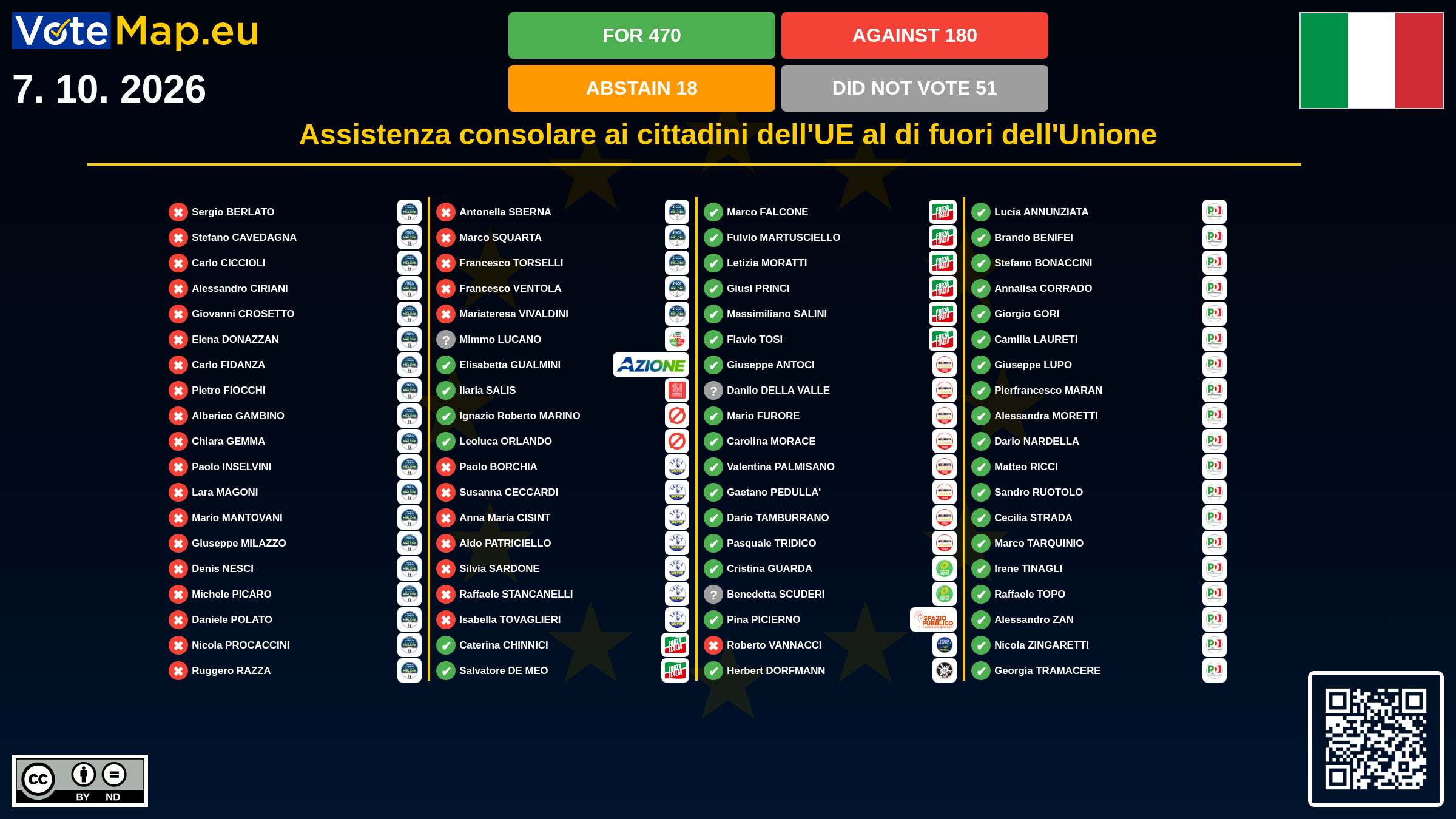
A citizen of the European Union who is travelling or living outside the Union may, in an emergency, turn to any other Member State if their own country does not have a diplomatic mission in that country. The rules governing this consular protection for unrepresented citizens are laid down in Directive (EU) 2015/637. This is supplemented by Directive (EU) 2019/997 on the EU emergency travel document. The proposal under discussion amends both.
This is not a standard legislative procedure in which the Parliament and the Council decide on an equal footing. It is a consultation process: the Council adopts the directive and the Parliament issues an opinion, which the Council is not obliged to follow. Parliament first expressed its views on the proposal on 24 April 2024. The Council then submitted an amended proposal on 11 February 2026 and requested a new consultation from Parliament. This vote is a response to that request. In its resolution, Parliament supported the proposal as amended by its own amendments. It called on the Council to inform it should it wish to deviate from this wording, and to consult it again should it substantially amend the proposal.
Parliament’s amendments cover three main areas. The first concerns who is considered to be unrepresented. Where, due to a crisis situation, a citizen cannot safely reach their own state’s authorities (or the authorities’ premises) within 48 hours, they are deemed unrepresented for that period and may request assistance from another Member State. Where local conditions are dangerous or prevent movement, the 48-hour time limit does not apply at all. Parliament also calls for vulnerable groups and people at risk of discrimination to be taken into account when providing assistance, with reference to Article 21 of the Charter of Fundamental Rights of the European Union.
The second area concerns funding. In serious cases, such as arrest, serious injury, serious illness or emergency repatriation, the state providing the assistance may seek reimbursement from the citizen’s home state for extraordinary costs, such as travel, accommodation or interpretation. Such assistance must be provided without discrimination compared to the state’s own citizens. At the same time, Parliament wants the European External Action Service (EEAS) to receive a commensurate increase in its budget and staffing levels, rather than relying solely on revenue from reimbursements by Member States.
The third area concerns the protection of personal data. The data of unrepresented citizens should only be transferred to third countries and international organisations with ‘the utmost caution’, only where this is directly related to the provision of protection, and always in accordance with the GDPR rules on data transfers outside the EU. The Commission is to evaluate the directive five years after its transposition into national law, rather than the current eight years. The text also contains a number of technical amendments, such as joint consular teams or SMS alerts for citizens in crisis.
The opinion was adopted by 470 votes in favour, 180 against, with 18 MEPs abstaining. The four groups of the pro-European majority voted unanimously in favour: the EPP (172 in favour, 1 abstention), the S&D (124 in favour), Renew (75 in favour) and the Greens/EFA (49 in favour). None of these groups has published a specific statement on the matter; their position is therefore reflected solely by their vote. The Left also voted in favour (39 in favour, 1 abstention). Three far-right groups voted against: the ECR (72 against, 7 in favour, 3 abstentions), PfE (66 against, 6 abstentions) and ESN (all 26 against).
The LIBE Committee’s rapporteur was Lena Düpont (EPP). The shadow rapporteurs were Marina Kaljurand for the S&D, Raquel García Hermida-van der Walle for Renew, and Tineke Strik for the Greens/EFA. The Council has the final say. The documents do not specify when the Council will decide on the directive.
We collect and visually present data publicly available at the page of European Parliament. Votemap.eu denies any responsibility for possible inconsistencies of the data or its changes after the publication.
Descriptions are created using DeepL Translate machine translation. We apologize for any possible imperfections or inconvenience.