The main strands of Member States’ employment policies
2026-10-21
The Council adopts the main guidelines for employment policy, and Parliament delivers its opinion on them. A resolution adding quality work, affordable housing and the goal of eradicating poverty by 2035 to these guidelines was passed by 434 votes in favour, 212 against and 23 abstentions. It was supported by the EPP, S&D, Renew and Greens/EFA – that is, the pro-European majority – as well as The Left. The far right, comprising the ECR, PfE and ESN, voted against it.
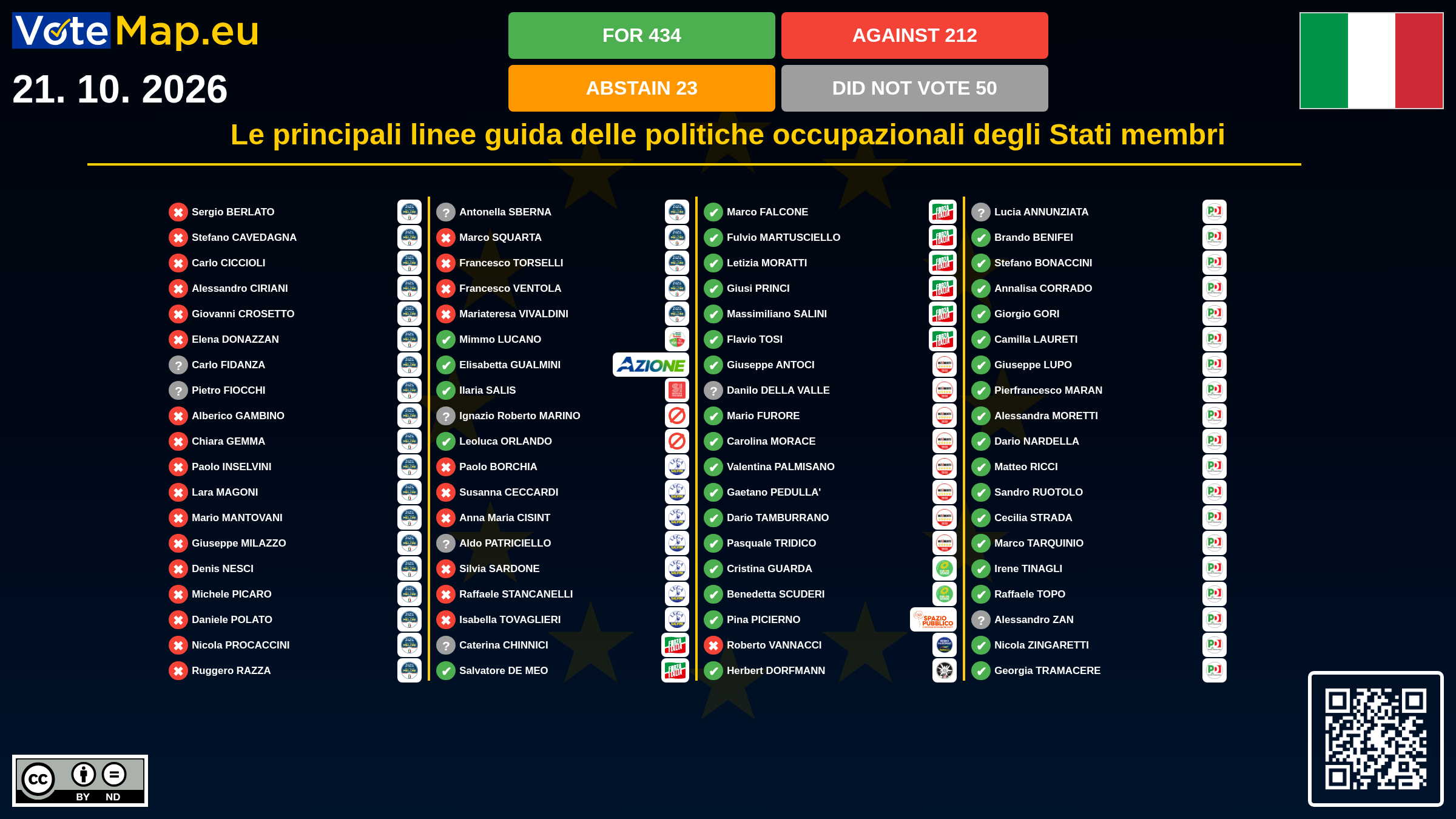
The EU Council adopts the Employment Guidelines by means of a decision. These guidelines set out the direction Member States should take in their employment policies. The proposal is submitted by the Commission; the current one is numbered COM(2026)0510. The Parliament does not have the power of codecision on the guidelines. This is a consultation under Article 148(2) of the Treaty on the Functioning of the EU: the Council must hear the Parliament’s views, but its amendments are not legally binding on the Council, which adopts the final text itself. The resolution is therefore a statement of position, not a final piece of legislation.
The report was drawn up in the Committee on Employment and Social Affairs (EMPL) by the rapporteur, Li Andersson (The Left, Finland). All four groups of the pro-European majority had shadow rapporteurs.
The resolution was adopted by 434 votes in favour, 212 against and 23 abstentions. The EPP voted in favour by a large majority (157 in favour, 12 against, 1 abstention), whilst the S&D voted in favour by an overwhelming majority (124 in favour, 2 against, 4 abstentions). Of these four groups, Renew was the least united: 55 voted in favour, 16 against and 3 abstained. The Greens/EFA voted unanimously in favour, with all 46 members voting. The far-left group The Left also voted in favour (39 in favour, 4 abstentions).
The far right opposed the motion: the ECR voted 75 against and 1 abstention, the PfE voted 73 against and 7 abstentions, and the ESN voted unanimously against (all 24 votes). The EPP did not join them in this vote.
The adopted text contains 33 amendments to the Commission’s text and rewrites most of the main guidelines themselves. The main changes are as follows.
Quality of work. The objective of a skilled workforce has been expanded to include quality employment and the improvement of working conditions. The text refers to the Directive on adequate minimum wages (EU) 2022/2041 and the Directive on pay transparency and equal pay for women and men (EU) 2023/970. It calls on Member States to transpose these fully into their national legislation.
Housing. Access to decent, sustainable and affordable housing, including public and social housing, is now included among the conditions for equal opportunities. The loss of one’s main residence through enforcement proceedings should be a last resort. With regard to homelessness, the text advocates the ‘housing first’ principle.
Poverty and pensions. In addition to the EU’s 2030 targets, a new target has been added to eradicate poverty by 2035. Particular attention is to be paid to single-parent households – most of which are headed by women – as well as to older women, migrant women and women with disabilities. On pensions, the text aims to reduce the gender pension gap, amongst other things by taking maternity and parental leave into account, and to ensure that pensions are above the poverty line.
Climate and cohesion. The text refers to the Just Transition Fund and the next multiannual financial framework. It aims to protect workers from climate-related risks, such as heatwaves and floods, and to involve people with disabilities and Roma in accessing the funds. It describes the European Pillar of Social Rights as a ‘social shield’.
A new introductory paragraph recalls that Parliament had already, in its resolutions of 2015, 2018, 2020, 2022, 2024 and 2025 that it be involved on an equal footing with the Council in setting the broad guidelines.
The resolution calls on the Commission to amend the proposal in line with the proposed amendments. It asks the Council to inform Parliament if it intends to deviate from the agreed text, and to consult Parliament again should it substantially amend the proposal. The Council will decide on the final form of the guidelines.
We collect and visually present data publicly available at the page of European Parliament. Votemap.eu denies any responsibility for possible inconsistencies of the data or its changes after the publication.
Descriptions are created using DeepL Translate machine translation. We apologize for any possible imperfections or inconvenience.