Women’s rights at the UN summit (CSW70): The European Parliament voted 340 to 141 to 68, with the centre-left groups unanimously in favour and the far right against
2026-02-12
The European Parliament has adopted a recommendation to the Council on the 70th session of the UN Commission on the Status of Women — calling for stronger protection against gender-based violence, support for UN Women following US funding cuts, and the Parliament’s involvement in shaping the EU’s position at CSW70. The S&D, Renew and Greens/EFA groups voted unanimously in favour, whilst the EPP voted in favour by a majority, though with nearly a fifth abstaining. The ECR, PfE and ESN groups voted against. Result: 340 in favour, 141 against, 68 abstentions.
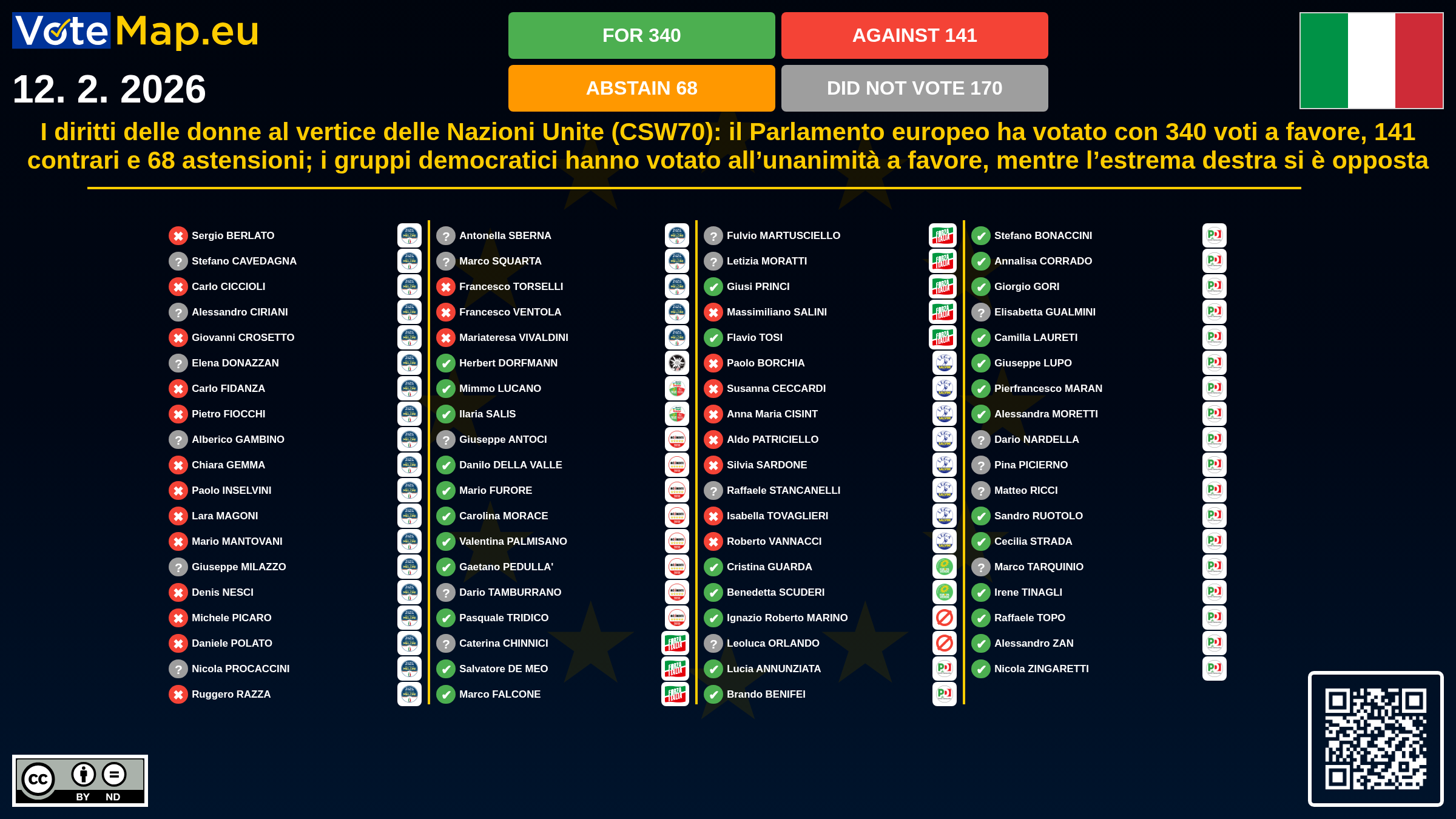
On Thursday 12 February 2026 in Strasbourg, the European Parliament adopted a recommendation to the Council of the EU on the priorities for the 70th session of the UN Commission on the Status of Women (CSW70). The report was led by rapporteur Lina Gálvez (S&D); the shadow rapporteurs were drawn from all four democratic groups — Maria Walsh (EPP), Heléne Fritzon (S&D), Lucia Yar (Renew) and Mélissa Camara (Greens/EFA) — as well as from the ECR and PfE.
The recommendation calls on the Council to advocate at CSW70 for the integration of women’s and girls’ rights into all EU external policies – trade, development and diplomacy – with an emphasis on access to justice; the defence of UN Women’s mandate and funding, including compensation for shortfalls following cuts to US development aid (USAID); stronger measures against gender-based violence, including its online forms – non-consensual sharing of intimate images, deepfakes and cyberharassment; a consent-based definition of rape as a global standard; recognition of gender apartheid as a crime against humanity under the Rome Statute; and the full involvement of Parliament and the Committee on Women’s Rights (FEMM) in shaping the EU’s position at the CSW.
The report was adopted by a vote of 340 in favour, 141 against, with 68 abstentions. The result reflects a consensus amongst the democratic centre: the S&D Group voted unanimously in favour (105:0, one abstention), as did Renew Europe (59:0, two abstentions) and the Greens/EFA (41:0, no abstentions). The EPP supported the report by a majority, but less unequivocally — 93 in favour, 15 against and 25 abstentions, meaning that almost a fifth of the group’s voting MEPs did not openly take sides. Together, the four democratic groups had 341 MEPs voting — more than was needed for adoption, regardless of the far-right’s stance.
The ECR (2:57, three abstentions), Patriots for Europe (PfE, 0:39) and Europe of Sovereign Nations (ESN, 0:24) voted against. In the case of PfE, however, the impression of unity is misleading: of the group’s 66 MEPs who voted, 27 – over 40 per cent – abstained, whilst only 39 actively voted against it; none voted in favour. The group’s actual position was thus more divided between opposition and reservation than a unified rejection. The ECR, PfE and ESN all voted against the report in this vote.
Lucia Yar, shadow rapporteur for Renew Europe, commented on the report: “Justice is the difference between rights on paper and rights in real life.” According to a Renew Europe press release dated 12 February, the group pushed for an emphasis on access to legal aid, services for victims, compensation from perpetrators and protection for those fleeing persecution. In its press release, which quotes rapporteur Gálvez and shadow rapporteur Fritzon, added on the subject of the report that Parliament is calling for decisive EU action in the fight against gender-based violence and in the defence of women’s equality worldwide.
We collect and visually present data publicly available at the page of European Parliament. Votemap.eu denies any responsibility for possible inconsistencies of the data or its changes after the publication.
Descriptions are created using DeepL Translate machine translation. We apologize for any possible imperfections or inconvenience.