The European Semester: debt, deficits and investment
2026-03-11
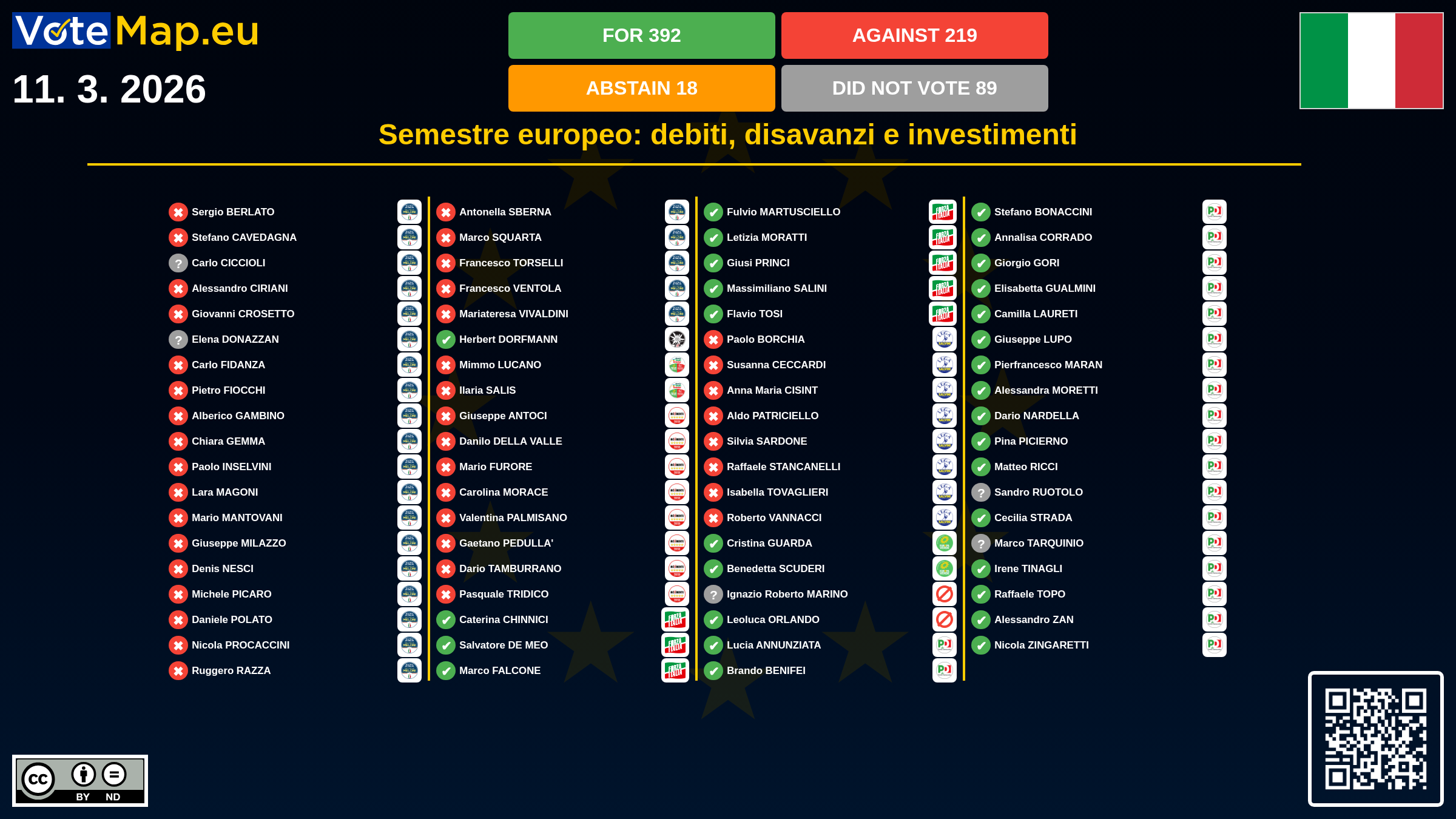
The resolution on the economic part of the 2026 European Semester was adopted by 392 votes in favour, 219 against, with 18 MEPs abstaining. It received almost unanimous support from the EPP, S&D, Renew and Greens/EFA; the rapporteur was Kira Marie Peter-Hansen (Greens/EFA). The ECR, PfE and ESN did not cast a single vote in favour, and The Left group was also predominantly against it. The text highlights rising public debt, deficits exceeding 3 per cent of GDP and an investment gap, which Draghi’s report put at 800 billion euros per year.
The European Semester is an annual cycle during which EU Member States coordinate their economic policies. The Committee on Economic and Monetary Affairs (ECON) drew up an own-initiative annual report on its economic component, and the Committee on Budgets (BUDG) issued an opinion on it. The rapporteur was Kira Marie Peter-Hansen (Greens/EFA), whilst Damian Boeselager (Greens/EFA) drafted the BUDG opinion.
The resolution outlines a forecast according to which the EU economy is set to grow at a rate of 1.4–1.5 per cent between 2025 and 2027, whilst its potential growth is declining due to demographic trends. According to the text, public debt is set to rise from 82.8 per cent of GDP in 2025 to 84.5 per cent in 2027. Twelve Member States are projected to run a deficit of over 3 per cent of GDP in 2027, and ten are subject to the excessive deficit procedure.
The second major issue is investment. The resolution refers to an investment gap, which Draghi’s report quantified at €800 billion per year; €450 billion of this relates to the energy transition. Added to this are defence expenditure under the ReArm Europe / Readiness 2030 plan, which is estimated at up to €800 billion. Sixteen Member States have invoked the national escape clause on account of this.
The resolution also contains criticism. It criticises the European Commission for never having initiated an excessive imbalance procedure (paragraph 38 of the resolution). In the explanatory statement (recital C), it notes that country-specific recommendations “regularly include cuts to social spending, whilst barely addressing the issue of increasing revenue”.
The resolution was adopted by 392 votes in favour, 219 against, with 18 MEPs abstaining. It was supported by all four groups of the pro-European majority: EPP 155 in favour, 4 against, 2 abstentions; S&D: 120 in favour, none against and none abstaining; Renew: 66 in favour, 2 against; Greens/EFA: 43 in favour, 4 abstentions. We were unable to find any specific statements from any of these groups regarding this vote; their position is therefore reflected in the vote – and it was almost unanimous across all four. Yet all of them had worked on the text: alongside the rapporteur from the Greens/EFA, there were also shadow rapporteurs from the EPP (Stefan Berger), the S&D (Matthias Ecke) and Renew (Ivars Ijabs).
Neither the ECR, PfE nor ESN cast a single vote in favour of the resolution. The ECR had 71 votes against and 3 abstentions; PfE had 57 against and 6 abstentions; and ESN had 23 against and 1 abstention. No MEP from the far right therefore voted in favour. The Left (far left) voted predominantly against: 1 in favour, 40 against, 2 abstentions. We do not have a statement from The Left regarding this vote.
On the same day, a second report on the European Semester, focusing on employment and social priorities, was also adopted; the rapporteur was Nela Riehl (Greens/EFA).
We collect and visually present data publicly available at the page of European Parliament. Votemap.eu denies any responsibility for possible inconsistencies of the data or its changes after the publication.
Descriptions are created using DeepL Translate machine translation. We apologize for any possible imperfections or inconvenience.