Agreement on an Enhanced Partnership between the EU and Uzbekistan
2026-05-20
The Agreement on an Enhanced Partnership and Cooperation between the EU and Uzbekistan was approved by the European Parliament by 493 votes in favour, 104 against and 45 abstentions. The EPP, S&D and Renew voted in favour, whilst the Greens/EFA were the only group within the pro-European majority to vote against. The EPP voted alongside the majority of the ECR and PfE. The result was not affected by this: even without the votes of the ECR, PfE and ESN, the agreement would have passed by 353 to 89.
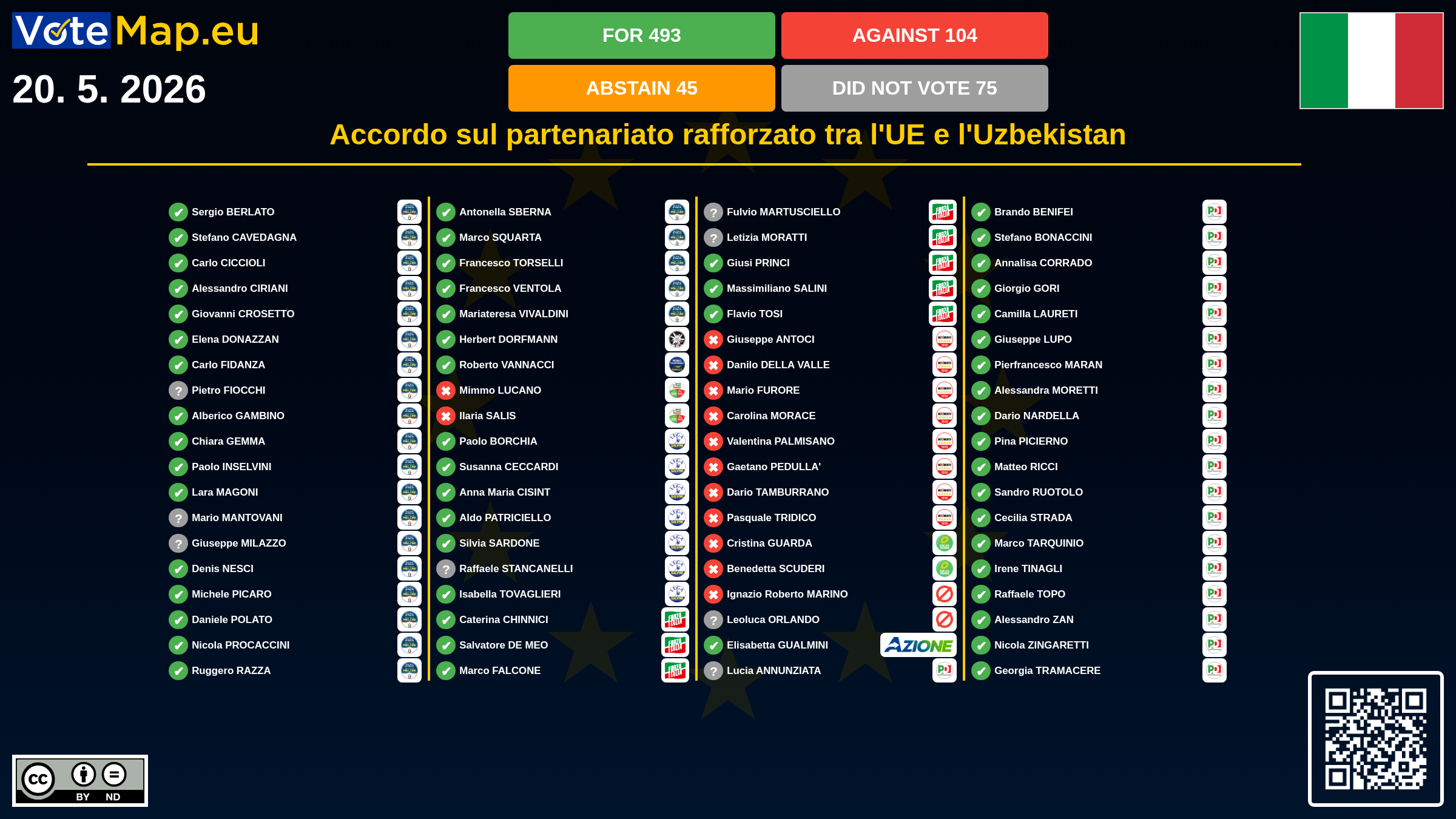
The Enhanced Partnership and Cooperation Agreement (EPCA) between the European Union and its Member States and Uzbekistan was signed by the parties on 24 October 2025. It extends the existing Partnership and Cooperation Agreement of 1 July 1999 and cannot enter into force without the consent of the European Parliament. The adopted text therefore consists solely of the granting of consent. The rapporteur was Ilhan Kyuchyuk (Renew).
According to a parallel resolution accompanying the agreement, Uzbekistan is the EU’s second-largest trading partner in Central Asia, with bilateral trade reaching almost €4.8 billion in 2024.
493 MEPs voted in favour, 104 against, and 45 abstained. The EPP (156 in favour) and Renew (71 in favour) voted unanimously in favour, whilst the S&D had 113 votes in favour and 5 abstentions. The Greens/EFA were the only group within the pro-European majority to vote against: 45 against, 4 abstentions, none in favour. The group’s shadow rapporteur was Ville Niinistö.
On the parallel non-legislative resolution on the same agreement, adopted by a vote of 423 in favour, 16 against and 208 abstentions, the Greens/EFA voted unanimously in favour (47 in favour, none against and no abstentions). They therefore supported the text containing reservations regarding Uzbekistan, but did not endorse the agreement itself.
The EPP voted alongside the majority of the ECR (65 in favour, 8 against, 2 abstentions) and the PfE (68 in favour, 7 against, 3 abstentions). The ESN largely abstained (7 in favour, 19 abstentions). The votes of the far right did not decide the outcome: the S&D and Renew also supported the agreement, and without the ECR, PfE and ESN, it would have passed by a margin of 353 to 89. The Left (far left) voted predominantly against (1 in favour, 37 against, 5 abstentions).
Rapporteur Ilhan Kyuchyuk (Renew) summarised at the end of the debate that MEPs differ in their priorities. Some emphasise geopolitics, whilst others focus on human rights, democratic reforms and civil society. According to him, however, there is broad consensus that relations with Uzbekistan are strategically, politically and economically important for the EU.
The accompanying resolution welcomes the agreement but also raises a number of concerns regarding Uzbekistan. It regrets that the human rights situation in Uzbekistan has deteriorated in certain areas since the start of negotiations on the agreement. It calls on Uzbekistan to end the persecution of human rights defenders, journalists and activists, and to release all those imprisoned for the peaceful exercise of their rights. It reiterates its concern over allegations of torture against the activist and lawyer Dauletmurat Tazhimuratov and joins the UN Working Group’s call for his immediate release. It is also concerned by mounting evidence that Uzbekistan is misusing instruments of international legal cooperation for the transnational repression of activists and journalists. It regrets that Uzbekistan has not condemned the Russian invasion of Ukraine and calls on the Uzbek authorities to prevent the circumvention of sanctions against Russia.
The resolution further calls on both parties to assess, within three years, the implementation of the agreement’s key elements against clear human rights standards. It also reiterates that tangible progress on democracy and human rights must be a condition for Uzbekistan’s continued access to EU trade preferences under the GSP+ scheme.
We collect and visually present data publicly available at the page of European Parliament. Votemap.eu denies any responsibility for possible inconsistencies of the data or its changes after the publication.
Descriptions are created using DeepL Translate machine translation. We apologize for any possible imperfections or inconvenience.