The United Nations Convention against Cybercrime
2026-05-20
The European Parliament has given its consent for the EU to accede to the UN Convention against Cybercrime, by 497 votes in favour, 91 against and 46 abstentions. The EPP voted alongside the ECR and PfE, whilst the S&D and Renew also supported the motion. The Greens/EFA were the only one of the four groups in the pro-European majority to vote against. The vote took place without debate.
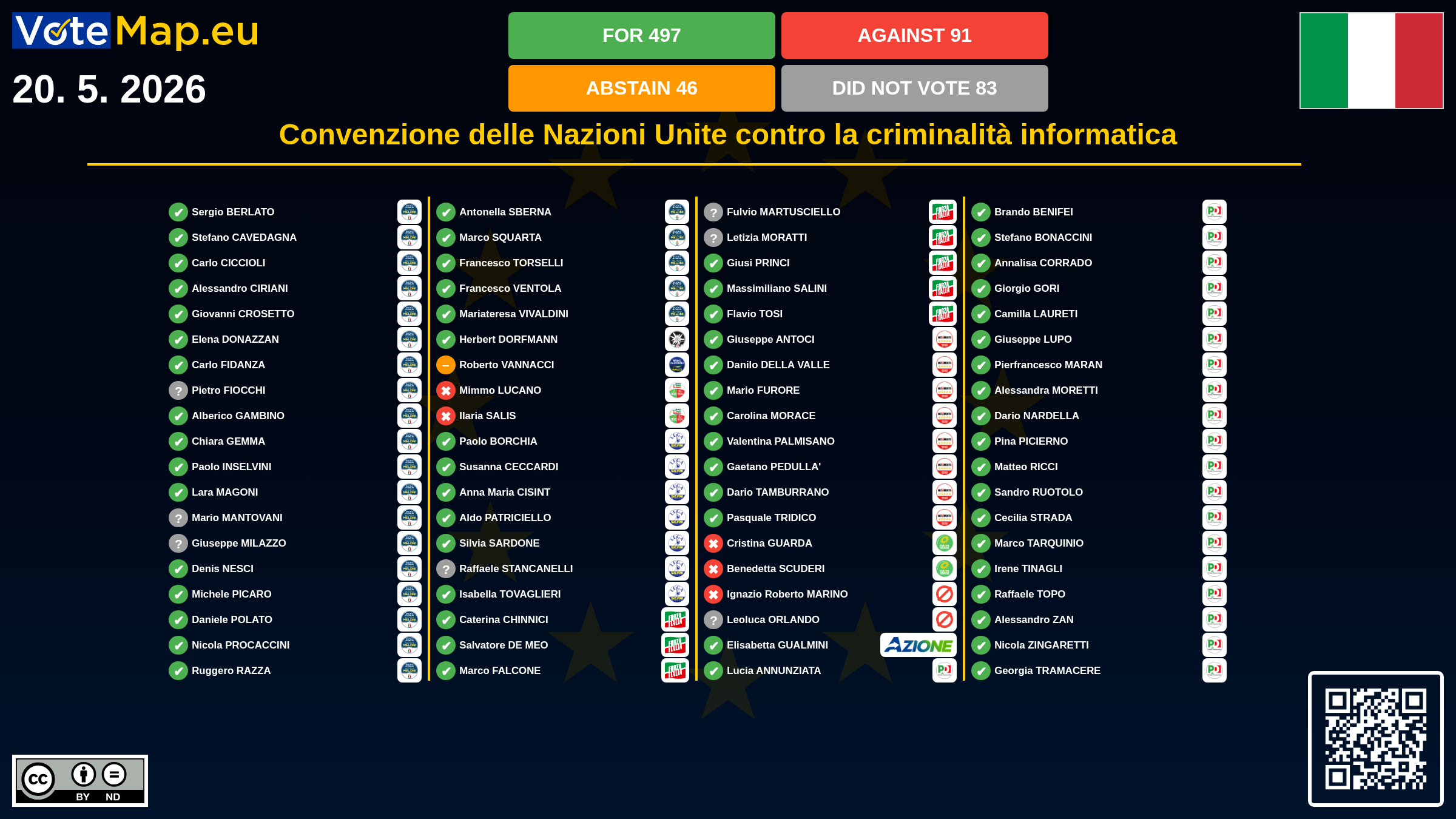
The European Parliament has given its consent to a draft Council decision whereby the European Union is to accede to the United Nations Convention on Cybercrime. 497 MEPs voted in favour, 91 against and 46 abstained. The vote took place without debate. Before the vote, only the rapporteur, Moritz Körner (Renew) from the Committee on Civil Liberties, Justice and Home Affairs (LIBE), took the floor.
The Convention is intended to facilitate international cooperation in the investigation and prosecution of offences defined therein. It is also intended to facilitate the sharing of electronic evidence in cases of serious crime, i.e. where the offence carries a prison sentence of at least four years. According to the official summary in the Parliament’s Legislative Observatory (OEIL), the Convention contains human rights safeguards. It precludes any interpretation that would lead to the suppression of freedom of expression, conscience, religion, peaceful assembly and association, and contains rules on the protection of personal data. In the committee’s explanatory report, rapporteur Körner also notes that the convention has drawn criticism from civil society and service providers, mainly regarding the protection of fundamental rights and values.
The EPP, S&D and Renew voted in favour, whilst the Greens/EFA voted against. The pro-European majority was therefore divided. The EPP voted unanimously in favour (159 in favour), as did Renew (72 in favour). The S&D supported the motion by a majority: 102 in favour, 1 against, 5 abstentions. The Greens/EFA voted against by an overwhelming majority: 47 MEPs against, 1 in favour, 1 abstention. They had already voted the same way in the LIBE Committee. There, all six members of the group present voted against; the committee’s final vote was 51:12:2.
The EPP voted alongside the ECR (73 in favour, 2 abstentions) and the PfE (70 in favour, 6 against, 3 abstentions). However, the S&D and Renew also supported the motion. The votes of the far right did not decide the outcome: without the ECR, PfE and ESN, the resolution would have passed by a margin of 352 votes in favour and 79 against. The ESN mostly abstained (18 MEPs), with 6 voting against and 2 in favour. The Left, i.e. the far left, voted split: 12 in favour, 22 against, 7 abstained.
Rapporteur Moritz Körner (Renew) said in the plenary before the vote (in German, translation by Votemap): “With the UN Convention against Cybercrime, we are improving international cooperation in the important area of cybercrime. The European Parliament was keen to ensure that privacy, fundamental rights and human rights were upheld in this context.” He added that, for him personally, the aim was to find a common line across the political spectrum in Parliament, “from left to right”, and thanked the shadow rapporteurs. All four groups of the pro-European majority had a shadow rapporteur; for the Greens/EFA, it was Markéta Gregorová. The Greens/EFA were, however, the only one of these four groups to vote against the motion.
We collect and visually present data publicly available at the page of European Parliament. Votemap.eu denies any responsibility for possible inconsistencies of the data or its changes after the publication.
Descriptions are created using DeepL Translate machine translation. We apologize for any possible imperfections or inconvenience.