Mandate to negotiate the rules on securitisation
2026-05-21
The mandate to negotiate with the Council on new rules for securitisation – that is, the sale of bundles of bank loans to investors – was approved in two votes by 294 to 192 (with 90 abstentions) and 294 to 194 (86 abstentions). The EPP, Renew and the majority of the S&D voted in favour, whilst the Greens/EFA voted against and some of their MEPs abstained – the pro-European majority was divided on this issue. The PfE and ESN – representing part of the far right – and The Left – representing the far left – also voted against; the ECR largely abstained.
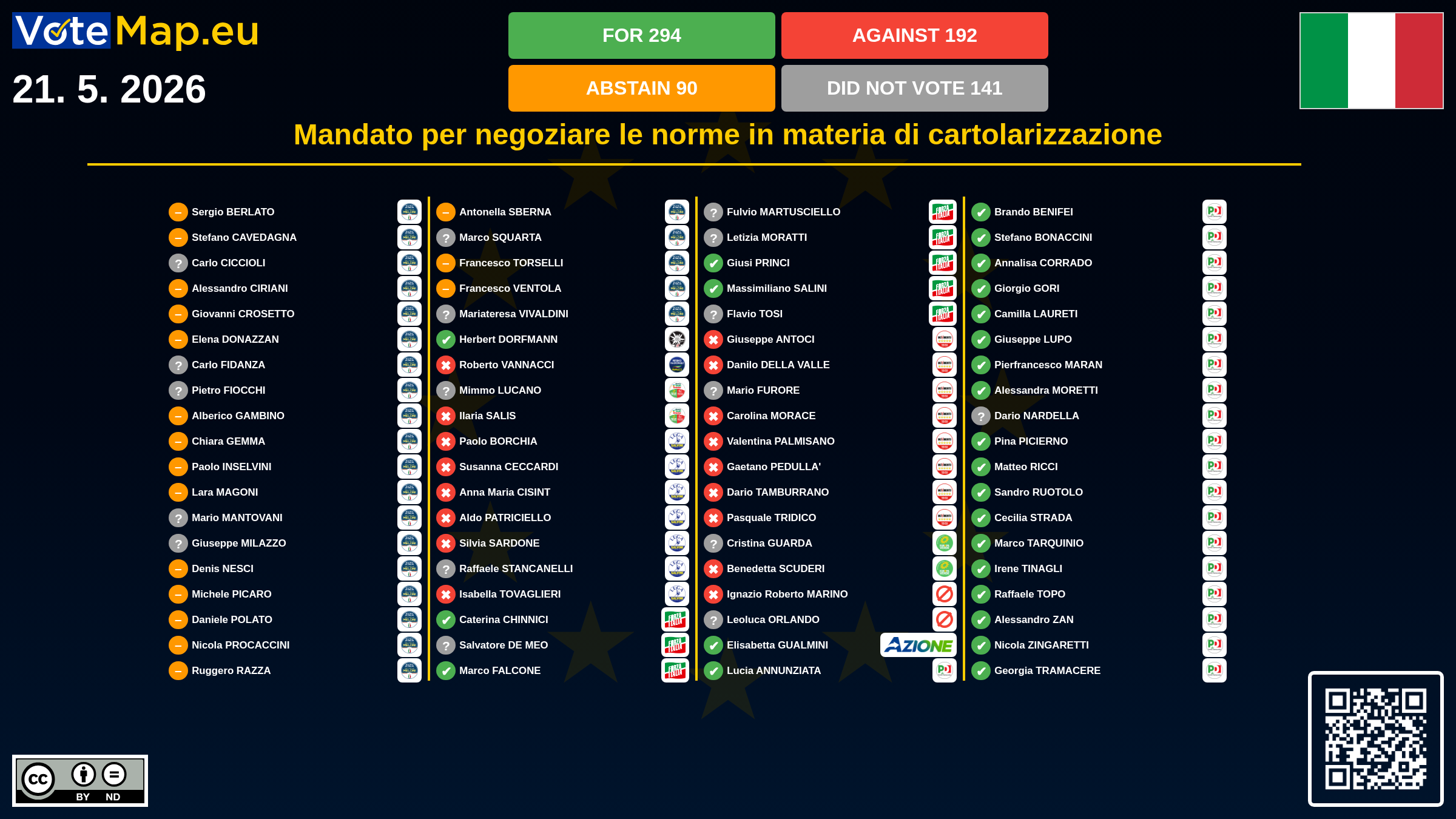
A vote was held on two related proposals from the securitisation package. Both were drafted by the rapporteur, Ralf Seekatz (EPP). The first proposal (report A10-0137/2026) amends the Capital Requirements Regulation (CRR) in the section on banks’ exposures to securitisation. The second (A10-0138/2026) amends the securitisation framework itself. This includes rules for so-called simple, transparent and standardised (STS) securitisation.
In securitisation, a bank bundles a large number of loans, such as mortgages, into a single package and then sells this on the financial markets as a security. Shadow rapporteur Marie Toussaint (Greens/EFA) pointed out during the debate that it was precisely this product that was at the root of the 2008 financial crisis.
The final text of the legislation has not yet been put to a vote. The decision concerned whether Parliament may, on the basis of reports from the ECON Committee, open negotiations with the Council – that is, a trilogue. Such a mandate is usually adopted without a vote in plenary. However, under Rule 72(2) of the Rules of Procedure, political groups may request a vote, and in this instance, the Greens/EFA and The Left did so.
The mandate was approved in both votes. On bank capital requirements, there were 294 votes in favour, 192 against and 90 MEPs abstained. On the securitisation framework, there were 294 votes in favour, 194 against and 86 abstentions. In both votes, the EPP voted in favour by a margin of 136 to 0, with one of its MEPs abstaining. Renew voted 65 to 0, also with one abstention. The S&D supported the mandate by a majority: 90 MEPs voted in favour and 16 and 15, respectively, against. The Greens/EFA voted against. Twenty-four and twenty-seven of its MEPs respectively voted against, seventeen and fourteen abstained, and one voted in favour.
Within the four groups of the pro-European majority, the dispute centred not only on securitisation itself, but also on how to proceed with the text. Rapporteur Seekatz (EPP) said in German during the debate that the committee had found a majority in favour of “an ambitious compromise that specifically strengthens the European securitisation market and ensures financial stability”. Gilles Boyer (Renew) justified the mandate in French by stating that this would fulfil the reports by Draghi, Letta and Noyer and launch a ‘union of savings and investment’. Jonás Fernández (S&D) spoke mainly about the procedure. According to him, the agreement reached in committee is supported by a pro-European majority. If the plenary were to reject the mandate and reopen the text, “anti-European forces” could table amendments, some of which might be adopted by “a different majority” in the Chamber.
The Greens/EFA, on the other hand, object to the content of the agreement. Marie Toussaint stated that, according to warnings from the European Central Bank, protection would be lower than it was before 2008. She called on her colleagues to vote on the mandate and for everyone to take responsibility for their vote.
Of the other groups, The Left – that is, the far left – voted unanimously against in both votes, 35:0. On the far right, the PfE (70 and 68 MEPs against, respectively, with 8 abstentions) and the ESN (22 against, with 2 abstentions) voted against. The ECR largely abstained, with 59 and 58 MEPs respectively, whilst 7 and 9 of its members voted against. An abstention does not count as a vote against.
They are only just beginning their mandate to negotiate with the Council. Any agreement reached must still be approved by Parliament in plenary and by the Council. Only then will the amendments to both regulations come into force.
We collect and visually present data publicly available at the page of European Parliament. Votemap.eu denies any responsibility for possible inconsistencies of the data or its changes after the publication.
Descriptions are created using DeepL Translate machine translation. We apologize for any possible imperfections or inconvenience.