Artificial intelligence and democratic oversight in the EU
2026-11-12
The resolution on the institutional aspects of artificial intelligence was adopted by 405 votes in favour, 133 against and 60 abstentions. It was unanimously supported by the S&D, Renew and Greens/EFA groups, and by an overwhelming majority of the EPP, whose member Emmanouil Kefalogiannis is the rapporteur. The ECR, PfE and ESN voted against it. The text insists that the democratic mandate must not be transferred to automated systems, and calls for the EU Charter of Fundamental Rights to be amended to include new rights, including protection against deepfakes.
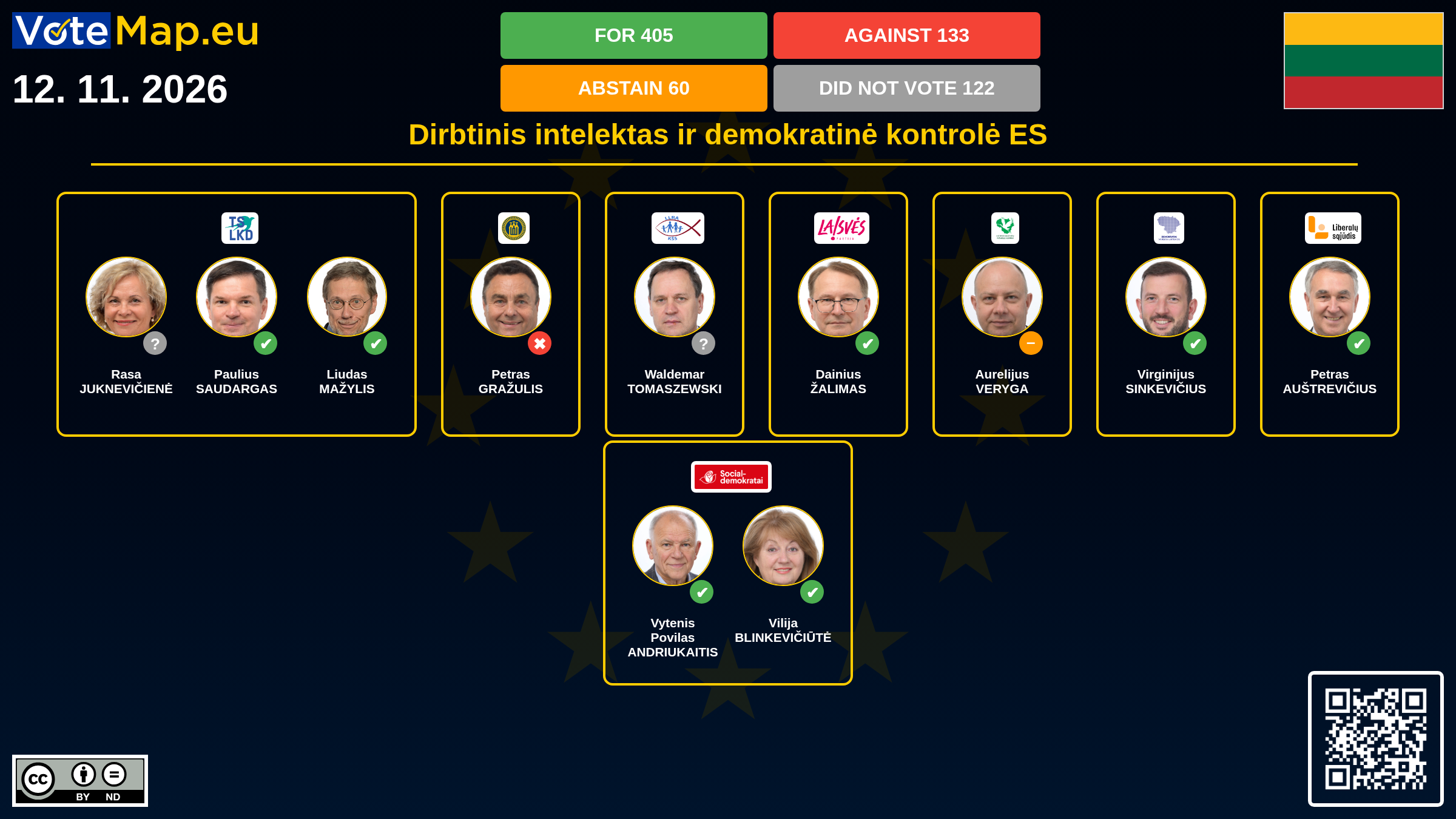
The resolution is based on a report by the Committee on Constitutional Affairs (AFCO), on which the IMCO and LIBE committees also gave their views. The rapporteur was Emmanouil Kefalogiannis (EPP), with shadow rapporteurs from, amongst others, the S&D, Renew and Greens/EFA groups. This is an own-initiative report (INI procedure), not a legislative proposal.
The underlying premise of the text is that the governance of artificial intelligence is not merely a matter of technical regulation, but a question of constitutional law and the EU’s institutional balance. The resolution therefore emphasises the need for robust and ongoing parliamentary scrutiny and insists that the ‘human in the loop’ principle must remain at the heart of EU institutional law. It also reiterates that the deployment of artificial intelligence within EU institutions must remain under full human oversight.
The second area concerns individual rights. The resolution calls for the Charter of Fundamental Rights of the EU to be amended to include rights that are emerging with the spread of artificial intelligence: the protection of personal identity and likeness against deepfakes, algorithmic transparency and digital self-determination, protection against algorithmic discrimination, and liability for damage caused. It also calls for the recognition of the right to meaningful human review of decisions adopted or supported by an artificial intelligence system within public administration. According to the text, artificial intelligence should remain purely an auxiliary tool within the judiciary and must not replace judicial decision-making.
The third area focuses on institutions. The resolution proposes an international convention on artificial intelligence with global oversight mechanisms, inspired by the model of the Treaty on the Non-Proliferation of Nuclear Weapons. It proposes considering the establishment of a specialised unit, which could be named the European Parliament’s AI Monitoring Centre. It should assist committees in building expertise, be of a supportive rather than regulatory nature, and operate on a budget-neutral basis. It emphasises the need for a strong and adequately funded Commission Office for Artificial Intelligence and stresses that the growing number of implementing acts and delegated acts must not undermine Parliament’s role as co-legislator.
The fourth area concerns democracy. The resolution calls for a systematic assessment of the risks posed by artificial intelligence to the integrity of elections, the spread of disinformation and foreign interference; it expresses concern about its potential impact on media pluralism and points out that the current EU electoral legal framework is insufficient to address the risks associated with AI.
405 MEPs voted in favour, 133 against and 60 abstained. The S&D (111), Renew (69) and Greens/EFA (42) voted unanimously in favour, whilst the EPP voted by an overwhelming majority (152 in favour, 1 against, 2 abstentions). The EPP, S&D, Renew and Greens/EFA – that is, the pro-European majority – thus accounted for 374 votes in favour, significantly more than the total number of votes against.
The ECR, PfE and ESN – that is, the far right – voted against. The ESN voted unanimously against (21 votes). None of the PfE members voted in favour; 46 MEPs voted against and part of the group abstained. The ECR voted mostly against (56 against, 2 in favour, 12 abstentions). We would point out that an abstention is not a vote against. The Left, that is, the far left, voted mostly in favour (25 in favour, 1 against, 11 abstentions).
We collect and visually present data publicly available at the page of European Parliament. Votemap.eu denies any responsibility for possible inconsistencies of the data or its changes after the publication.
Descriptions are created using DeepL Translate machine translation. We apologize for any possible imperfections or inconvenience.