Objection to the authorisation of genetically modified soya
2026-04-29
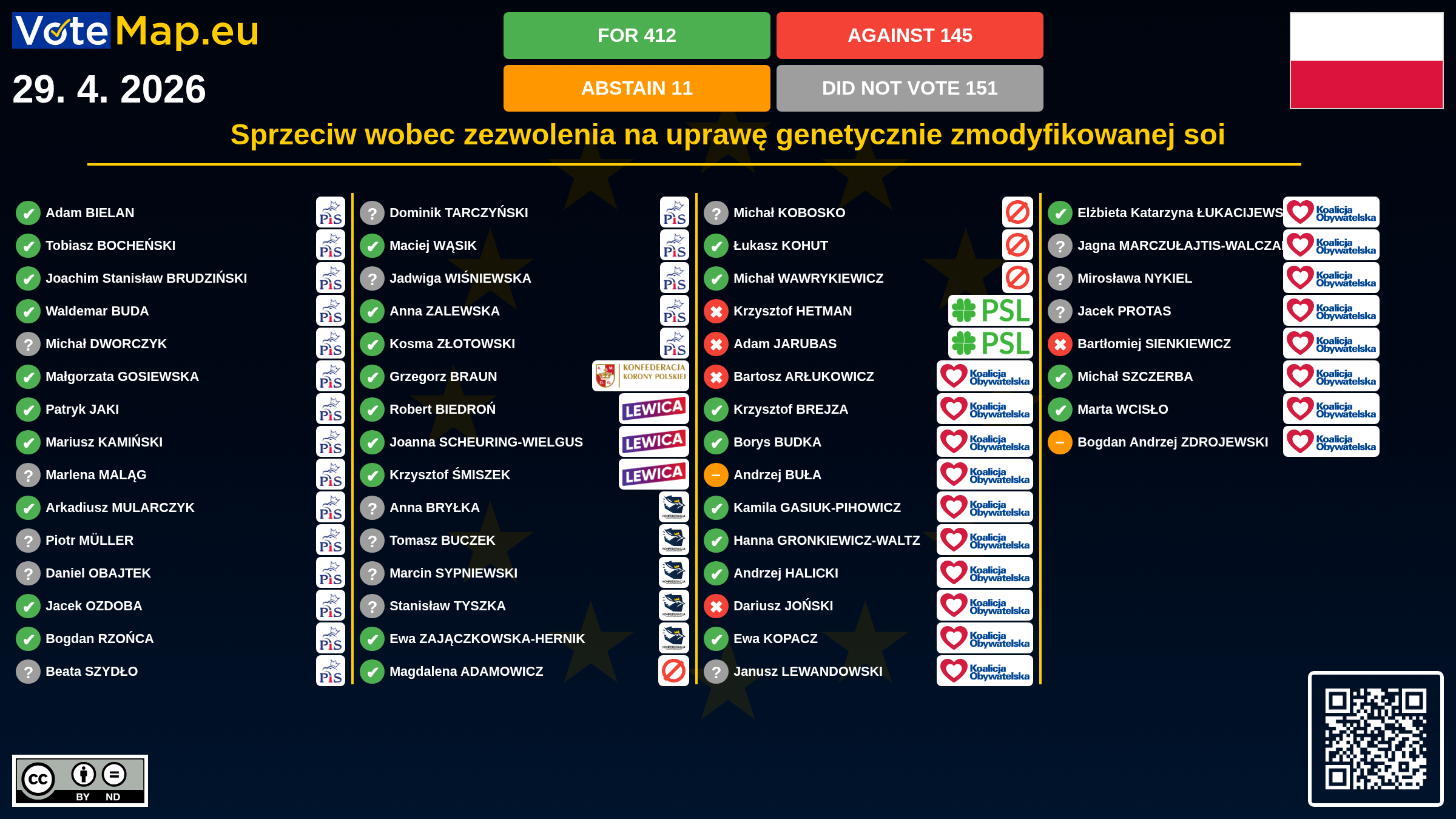
The ENVI Committee’s objection to the authorisation of genetically modified soya MON 94637 was adopted by the plenary by a vote of 412 to 145, with 11 MEPs abstaining. The S&D and Greens/EFA groups voted in favour, Renew was split almost down the middle (30 to 29 to 1) and the EPP voted split (50 to 87 to 4), although its MEP Sirpa Pietikäinen had co-tabled the objection on behalf of the committee. The pro-European majority was thus split. The ECR, PfE and ESN also voted in favour of the objection, but their votes did not determine the outcome.
The European Commission has proposed authorising the placing on the market of products derived from genetically modified MON 94637 soya. It is acting in accordance with Regulation (EC) No 1829/2003 on genetically modified food and feed. The Member States have not reached a decision on the proposal. No qualified majority was achieved either in the Standing Committee on Plants, Animals, Food and Feed on 27 February 2026 or in the Appeal Committee on 31 March 2026. The European Food Safety Authority (EFSA) had previously issued a favourable opinion. According to the Authority, this soya is just as safe as conventional varieties.
The Committee on the Environment, Public Health and Food Safety (ENVI) lodged an objection to the Commission’s proposal. Four MEPs tabled the objection on behalf of the committee: Sirpa Pietikäinen (EPP), Biljana Borzan (S&D), Martin Häusling (Greens/EFA) and Anja Hazekamp (The Left). The adopted resolution criticises the fact that the molecular characterisation of the soya is incomplete, that the chimeric Bt proteins Cry1A.2 and Cry1B.2 have not been sufficiently investigated, and that the risk assessment is incomplete. The text also points out that the Commission continues to authorise genetically modified organisms even though it lacks the support of Member States and the Parliament has repeatedly raised objections to them.
The objection was passed by 412 votes in favour and 145 against, with 11 MEPs abstaining. A simple majority of the votes cast was sufficient for this. However, the pro-European majority groups each voted differently. The S&D Group voted in favour and was the most united of the four groups: 102 in favour, 1 against, 5 abstentions. The Greens/EFA also voted in favour (39 in favour, 3 against). Renew was split almost exactly down the middle: 30 of its MEPs voted in favour, 29 against and 1 abstained. The EPP was divided: 50 in favour, 87 against and 4 abstained. The objection was, however, co-tabled on behalf of the committee by one of its own MEPs. We do not know from the available documentation how Sirpa Pietikäinen voted personally. None of the four groups issued a separate statement on the vote; their position is therefore indicated solely by how they voted.
The far-right groups ECR (55 in favour, 13 against), PfE (55 in favour, 10 against) and ESN (22 in favour, none against) also voted in favour of the objection. They did not decide the outcome: without their votes, the objection would have passed by a margin of 280 to 122. The far-left group The Left, whose MEP Anja Hazekamp was one of the proposers, voted unanimously in favour (37 to 0).
An objection is not a veto. The resolution refers to Article 11 of Regulation (EU) No 182/2011. This requires the Commission to review the proposal and inform Parliament whether it will maintain, amend or withdraw it. It is not obliged to withdraw it automatically. The European Parliament’s Legislative Observatory (OEIL) has recorded the Commission’s response to the adopted text dated 17 August 2026. The content of this response is not available on Votemap.
According to a note in the adopted text, this is already the 24th resolution in this parliamentary term opposing the authorisation of a genetically modified organism. Four of the previous ones were adopted on 11 February 2026 and concerned soya, maize and two varieties of cotton. According to the same text, Parliament adopted 36 such resolutions in the eighth parliamentary term and 38 in the ninth.
We collect and visually present data publicly available at the page of European Parliament. Votemap.eu denies any responsibility for possible inconsistencies of the data or its changes after the publication.
Descriptions are created using DeepL Translate machine translation. We apologize for any possible imperfections or inconvenience.