Transfer of passenger data to Norway and Iceland
2026-04-29
The European Parliament approved the EU’s agreement with Norway on the transfer of passenger name record (PNR) data by 532 votes to 72, with 26 abstentions, and a similar agreement with Iceland by 532 votes to 75, with 28 abstentions. The EPP, S&D and Renew voted in favour, whilst the Greens/EFA voted against, meaning the pro-European majority was split. The EPP voted alongside the ECR and PfE, but their votes did not determine the outcome. The Left voted mostly against, whilst the ESN was divided.
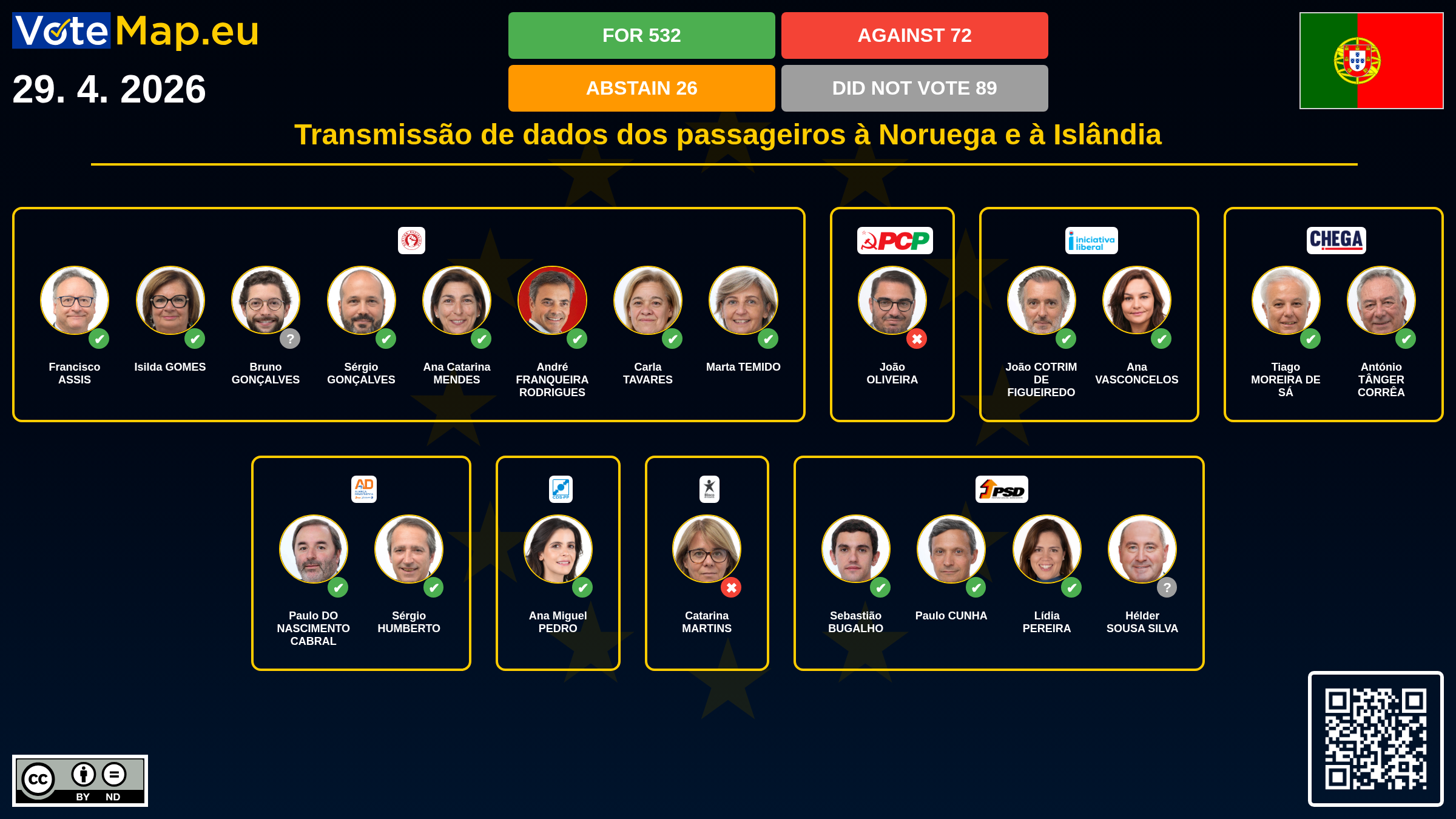
The European Parliament has given its consent to two international agreements concluded by the European Union, one with Norway and one with Iceland. Both agreements set out how air carriers are to transfer passenger name record (PNR) data to the Norwegian and Icelandic passenger information units. The agreement with Norway was supported by 532 MEPs, with 72 voting against and 26 abstaining. The agreement with Iceland received 532 votes in favour, 75 against and 28 abstentions. This was a consent procedure: Parliament did not amend the text of the agreements; it could only approve or reject them. There was no separate debate on them in plenary.
The pro-European majority was split equally in both votes. The EPP voted unanimously in favour (161 votes for Norway, 163 for Iceland), as did Renew (66 in favour for both). The S&D voted almost unanimously in favour, with only 2 and 4 of its MEPs, respectively, abstaining. Greens/EFA was the only one of the four groups to vote against, with 34 against, 3 in favour and 7 abstentions on both agreements. None of the four groups issued their own statement on these votes that could be traced, so we describe their position based on how they voted. It is not clear from the available documentation why the Greens/EFA opposed the agreements.
The groups were already divided in the LIBE Committee, where the vote took place on 18 March 2026. On the Norway vote, there were 51 votes in favour, 8 against and 3 abstentions; on the Iceland vote, 49 in favour, 8 against and 3 abstentions. All Greens/EFA members present voted against, as did four members of The Left.
On the far right, both the ECR (80 votes for Norway, 81 for Iceland) and the PfE (75 for both) voted unanimously in favour. The EPP therefore voted alongside the ECR and the PfE; however, their votes did not determine the outcome, and the agreements would have been adopted even without them. The ESN was divided: on Norway, 19 in favour, 3 against and 5 abstentions; on Iceland, 18 in favour, 3 against and 6 abstentions. The far left, namely The Left, was largely opposed: 29 against, 10 in favour and 3 abstentions on the Norway agreement; 32 against, 9 in favour and 3 abstentions on the Iceland agreement.
The rapporteur for both reports in the LIBE Committee was Jaroslav Bžoch from the PfE Group.
Under the agreements, PNR data may only be used for the prevention, detection, investigation and prosecution of terrorist offences and serious criminal offences. This list of purposes is exhaustive. The transfer of data must be limited to the strict minimum, and the processing of special categories of data – that is, sensitive data within the meaning of EU data protection law – is prohibited. Both the Norwegian and Icelandic authorities must depersonalise the data within six months at the latest. Norway and Iceland must comply with the same rights and obligations regarding processing as laid down in Directive (EU) 2016/680, and supervision must be carried out by an independent authority. Data breaches must be reported to the supervisory authority, and records must be kept of all processing activities. The agreements also regulate the exchange of data with the authorities of Member States, Europol and Eurojust, as well as the rules governing the disclosure of such data outside Norway, Iceland and the EU.
On 24 July 2025, the European Data Protection Supervisor (EDPS) issued two opinions on the agreements: Opinion 16/2025 on Norway and Opinion 15/2025 on Iceland. We have been unable to obtain the full texts of these opinions and therefore do not set out their conclusions.
Following Parliament’s approval, the Council formally concluded both agreements on 4 June 2026. Decisions 2026/1916 (Norway) and 2026/1918 (Iceland) were published in the Official Journal on 6 August 2026.
We collect and visually present data publicly available at the page of European Parliament. Votemap.eu denies any responsibility for possible inconsistencies of the data or its changes after the publication.
Descriptions are created using DeepL Translate machine translation. We apologize for any possible imperfections or inconvenience.