Rules for the protection of retail investors
2026-11-12
The European Parliament’s plenary session rejected the provisional agreement with the Council on rules to protect retail investors by 286 votes in favour, 300 against and 23 abstentions. The EPP and Renew supported the agreement, whilst the S&D and Greens/EFA voted against it, meaning the pro-European majority split into two camps. The PfE also voted in favour for the most part, whilst the ECR was divided in its vote. The sister PRIIPs Regulation from the same package was passed on the same day.
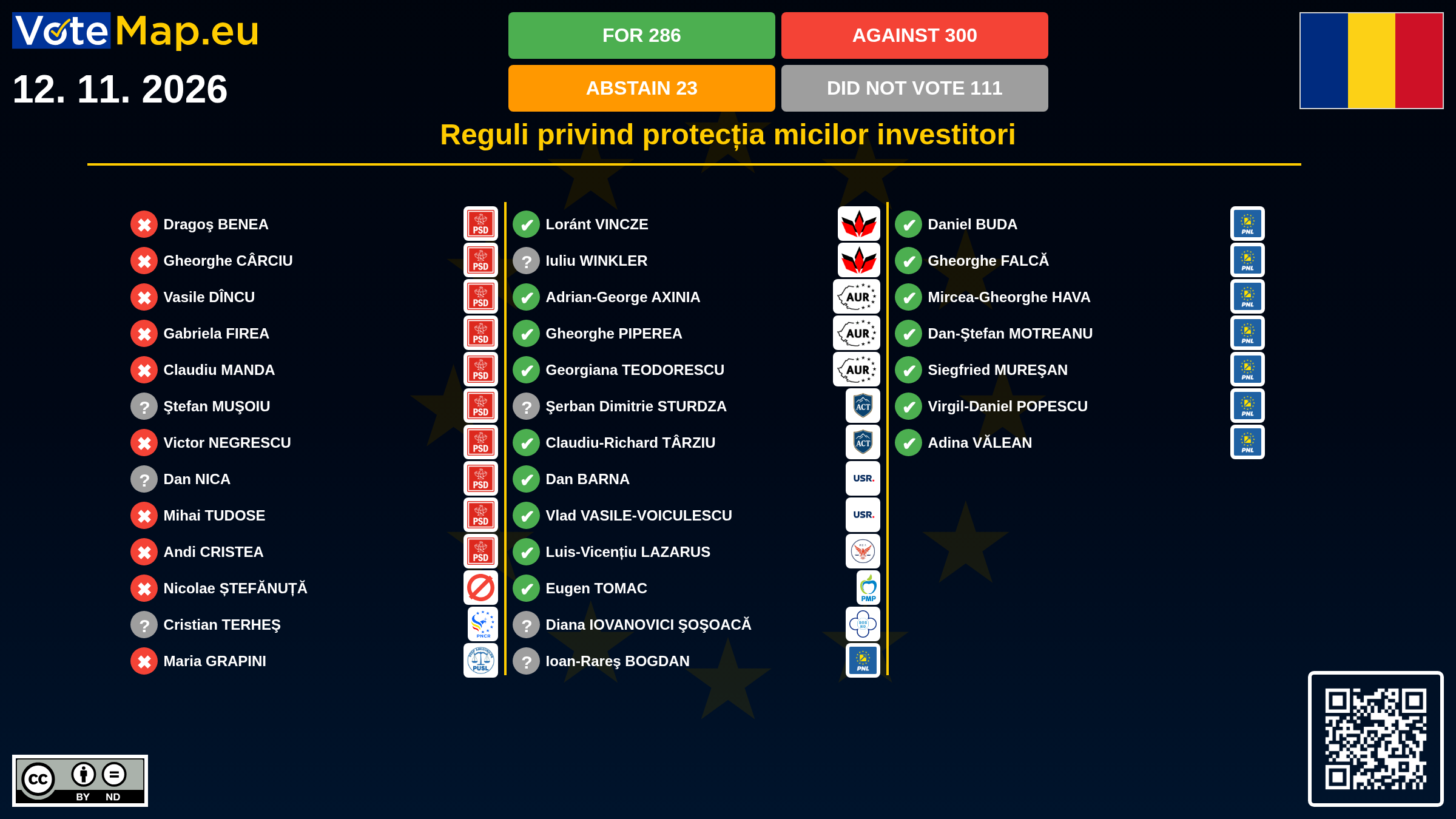
The vote was on the provisional agreement – that is, the text on which Parliament and Council negotiators had reached agreement in December 2025 and which still required the plenary’s approval. It concerns rules to protect retail investors as part of the so-called Retail Investment Strategy. The directive would amend five existing pieces of legislation in the fields of investment, securities and insurance: Solvency II, UCITS, AIFMD, MiFID II and IDD. The rapporteur was Stéphanie Yon-Courtin (Renew), whilst the shadow rapporteurs for the EPP, S&D and Greens/EFA were Ralf Seekatz, Eero Heinäluoma and Vladimir Prebilič.
When the agreement was reached, the Renew Group presented it as a way to encourage more Europeans to invest. According to the group, financial influencers should be held accountable for the recommendations they make to people online; a comparison website for financial products should be set up; and experienced investors should be able to switch to the professional category. Yon-Courtin stated at the time that financial influencers on the internet had become “financial advisers 2.0”.
286 MEPs voted in favour of the agreement, 300 against and 23 abstained, meaning it failed to pass by 14 votes. The EPP supported it by a majority: 123 in favour, 34 against, 1 abstention. Renew voted in favour by an overwhelming majority (63 in favour, 3 against, 1 abstention). On the opposite side were the S&D, all 116 of whose voting MEPs were against, and the Greens/EFA, with 46 votes against and none in favour.
The dispute runs right through the pro-European majority. This split into two groups: one that supported the negotiated compromise, and one that rejected it. The EPP and Renew, whose ranks include the rapporteur, backed the text agreed with the Council; the S&D and Greens/EFA unanimously rejected it. The S&D had long opposed the compromise. As early as March 2024, when the ECON Committee approved its compromise, she criticised the fact that, unlike the Commission, rapporteur Yon-Courtin’s proposal did not include any ban on so-called ‘inducements’, that is, commissions paid by firms to intermediaries. S&D negotiator Eero Heinäluoma stated in April 2024: “Europeans should be able to save for their own pensions, not for their bankers’ pensions.” Both statements relate to an earlier stage of the negotiations, not the final agreement.
The PfE also largely supported the agreement (47 in favour, 14 against, 6 abstentions), whilst the ECR voted split (45 in favour, 21 against, 4 abstentions). The ESN was against (17 against, 6 abstentions), so the far right did not vote as a bloc. The Left (far left) voted against with all 37 of its members. The EPP therefore stood on the same side as the ECR and PfE, but this coalition was defeated. In addition to the S&D and Greens/EFA, 34 EPP MEPs also opposed the agreement.
On the same day, the plenary adopted the sister PRIIPs Regulation from the same package, also with Yon-Courtin as rapporteur, by 311 votes in favour, 261 against and 38 abstentions. In that case, the majority was composed differently: the regulation was supported by the EPP and Renew, together with the ECR and PfE, and was passed thanks to the votes of the ECR and PfE (the ESN largely abstained). These are two separate legal acts and two separate plenary decisions – the plenary rejected the directive on the protection of retail investors but approved the PRIIPs Regulation.
We collect and visually present data publicly available at the page of European Parliament. Votemap.eu denies any responsibility for possible inconsistencies of the data or its changes after the publication.
Descriptions are created using DeepL Translate machine translation. We apologize for any possible imperfections or inconvenience.