The gender gap in healthcare and the divide over abortion
2026-09-16
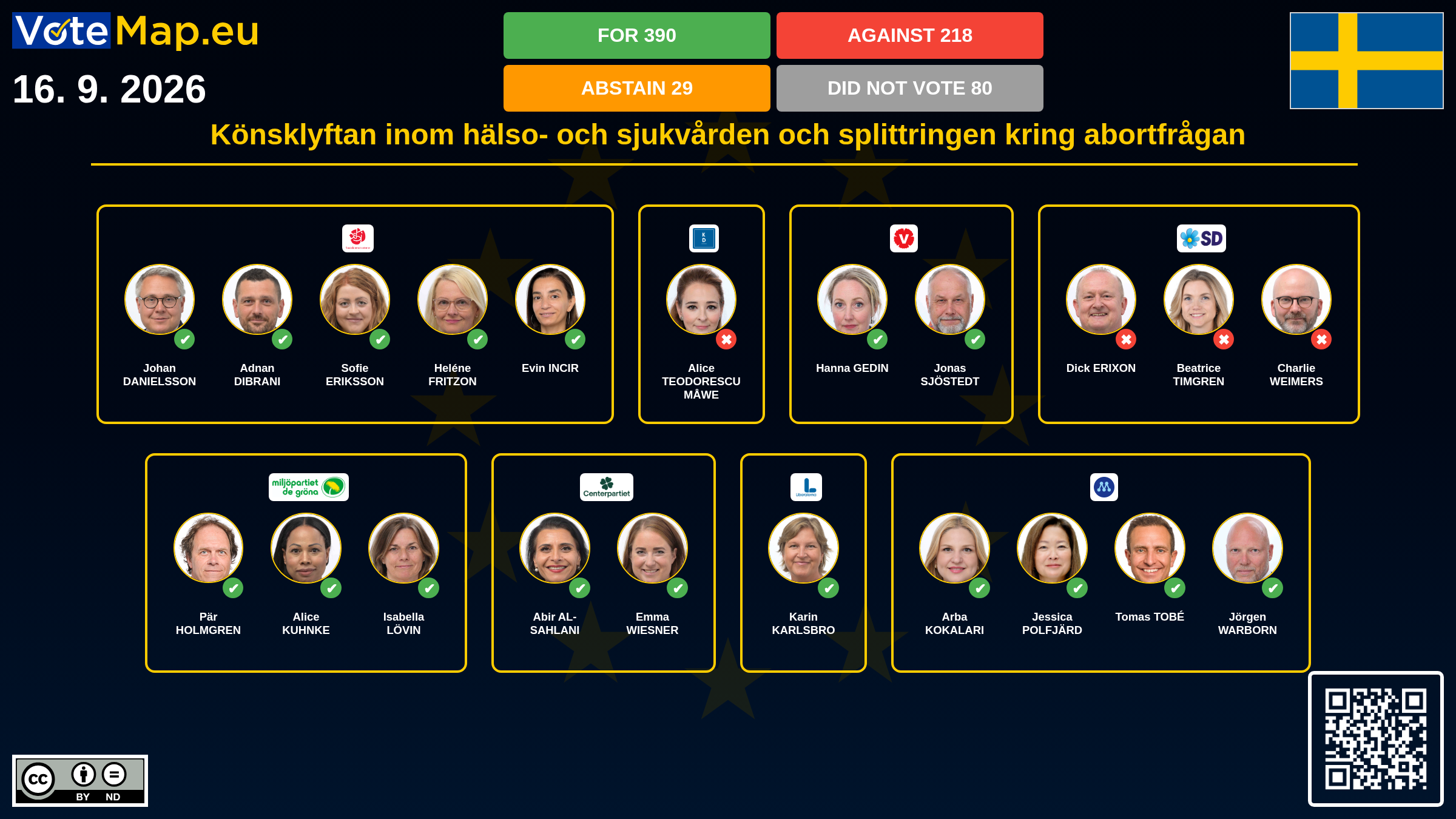
The European Parliament adopted a resolution on gender inequalities in healthcare by 390 votes to 218, with 29 MEPs abstaining and an attendance rate of 88.8 per cent. The report calls for mandatory gender-sensitive research, the collection of data disaggregated by sex, and a strategy for women’s health, as well as measures to address forced abortions, sterilisation and obstetric violence. The S&D, Renew and Greens/EFA groups voted unanimously in favour; the EPP was split almost down the middle and was the only one of the four democratic groups to end up with a majority voting against.
On Wednesday 16 September 2026 in Strasbourg, the European Parliament adopted a resolution by the Committee on Women’s Rights and Gender Equality on gender inequalities in healthcare (report by Billy Keleher, Renew, A10-0200/2026). The text is based on the fact that medical research has, for decades, been built predominantly around male anatomy: 72 per cent of drug trial studies do not provide data disaggregated by sex, and only 5 per cent of global research funding is allocated to women’s health. The resolution therefore calls for mandatory gender-sensitive research design, the collection of sex-disaggregated data in all EU-funded projects, a gender perspective within the European Health Data Space, and clear, measurable targets as part of the EU’s strategy for women’s health — including, amongst other things, previously neglected areas such as endometriosis, the menopause, cardiovascular disease and infertility.
The resolution further calls for measures to address forced abortions, forced sterilisation, the denial of access to abortion services, intersex genital mutilation and obstetric and gynaecological violence, alongside ensuring high-quality maternity care. At the same time, the text – a new development compared to the committee stage – emphasises that health policy must be based on “robust scientific evidence and objective biological facts”, and calls for support for healthcare innovation whilst reducing the regulatory burden. It is precisely this combination of a factually uncontroversial agenda (more data, more research) with value-laden passages on abortion that is causing the consensus to fracture.
Parliament adopted the resolution by 390 votes in favour, 218 against, with 29 abstentions. The S&D Group (122:0, one abstention) voted without a single vote against, whilst Renew (71:0) and the Greens/EFA (49:0) voted unanimously in favour. The EPP is the only one of the four democratic groups to have been divided — 69 in favour, 74 against, practically split down the middle — and thus, as a whole, ended up opposing the resolution by a plurality, even though the EPP’s shadow rapporteur, Maria Walsh, had co-negotiated the text. Rapporteur Billy Kelleher (Renew) commented on the vote, stating that women’s health had long been underfunded and overlooked, and that Parliament was today sending a clear signal that it must move higher up the political agenda.
A more accurate description than ‘Parliament approved’ or ‘the EPP voted with the far right’ is three-way: the resolution passed thanks to the united support of the S&D, Renew, Greens/EFA and The Left, plus a minority within the EPP, against opposition from the majority of the EPP, ECR, ESN and the narrowly divided PfE (33:37). The ultra-conservative ECR+PfE+ESN bloc was against (36:131), but this time it did not tip the balance — unlike in votes where the EPP sides with the far right, here the EPP ended up among the losers. Overall turnout stood at 88.8 per cent (637 out of 717 seats); of all the relevant groups, the EPP had the lowest turnout (84.2 per cent) and the highest proportion of abstentions, whilst the Greens/EFA had the highest turnout among the democratic groups (92.5 per cent).
We collect and visually present data publicly available at the page of European Parliament. Votemap.eu denies any responsibility for possible inconsistencies of the data or its changes after the publication.
Descriptions are created using DeepL Translate machine translation. We apologize for any possible imperfections or inconvenience.