The EU’s Strategy for the Protection of International Justice
2026-11-25
By a vote of 438 in favour and 168 against (with 38 MEPs abstaining), the European Parliament adopted a resolution on the EU’s strategy for the protection of international justice. The text condemns coercive measures against international judicial institutions and supports officials of the International Criminal Court who have been subjected to sanctions by the current US administration. The EPP, S&D, Renew and Greens/EFA – the pro-European majority – voted in favour, as did The Left. The ECR, PfE and ESN – the far right – voted against.
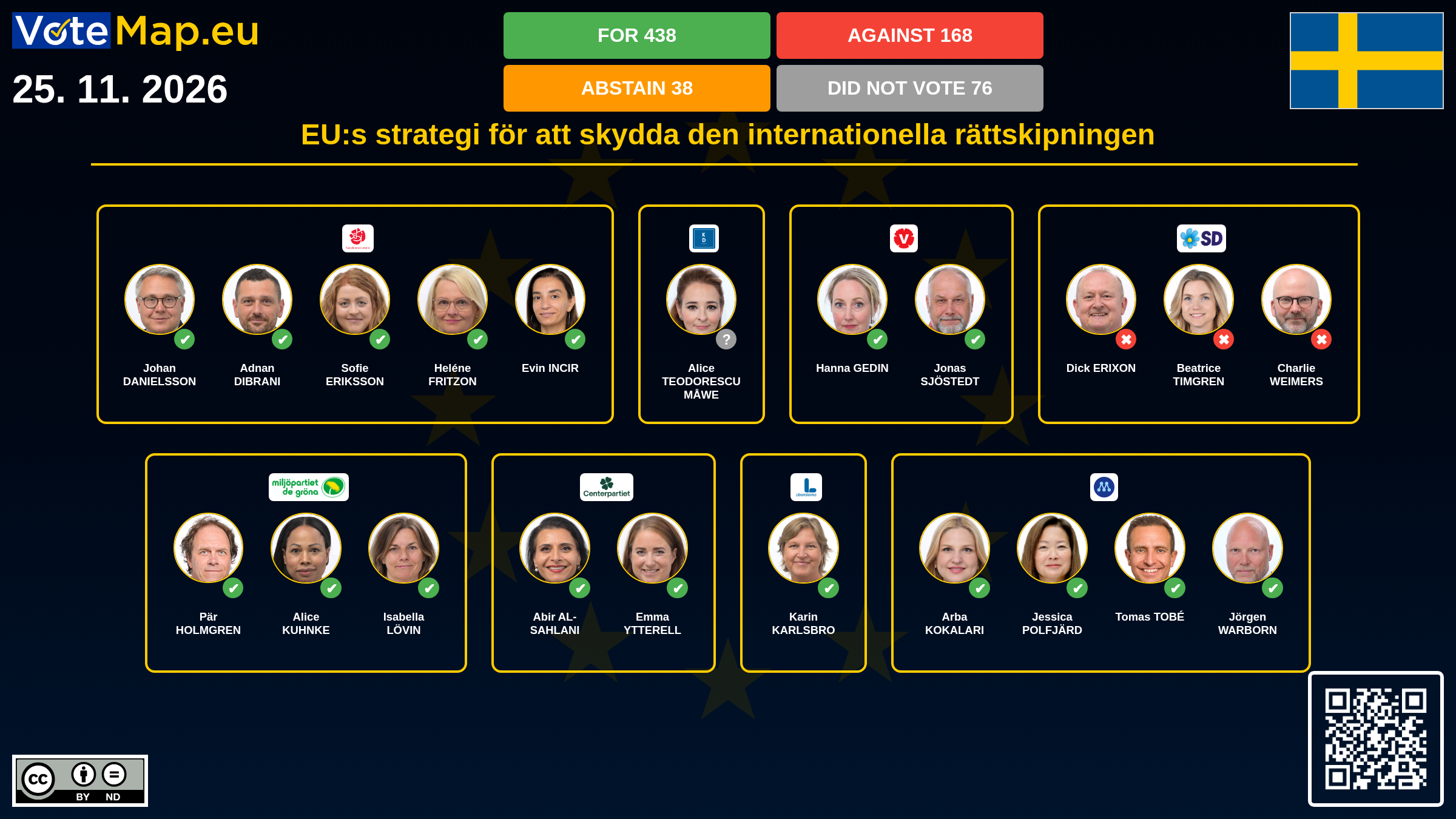
The resolution is based on the report by the Committee on Foreign Affairs (AFET), drawn up by the rapporteur, Mounir Satouri (Greens/EFA). It has no legislative effect: it sets out how the EU should protect international justice, its institutions and partners, but does not create any new legislation.
The resolution welcomes the fact that the 2026 Sakharov Prize was awarded to the International Criminal Court (ICC) and its officials, particularly as the Court itself became subject to US sanctions on 9 October 2026. These sanctions are based on US Presidential Decree No. 14203 of 6 February 2025, entitled ‘Imposition of Sanctions on the International Criminal Court’. According to the text, the US government gradually imposed sanctions on ICC officials during 2025 (asset freezes, travel bans, restrictions on access to financial and digital services) and, in July and September 2025, also introduced coercive measures against UN mandate holders and Palestinian organisations cooperating with the ICC. In July 2026, the US launched a campaign to “eliminate the threat posed by the ICC to American sovereignty” and, in August 2026, imposed sanctions on a further two officials of the Court, including its President. The resolution strongly supports the ICC officials against whom the current US administration has imposed sanctions, and commends them for continuing to fulfil their judicial mandate despite this.
The second party mentioned is Russia. In March 2023, the Investigative Committee of the Russian Federation initiated criminal proceedings against ICC officials for alleged ‘unlawful prosecution’; in May 2023, the Ministry of the Interior of the Russian Federation placed the ICC Prosecutor on the federal wanted list, and in December 2025, verdicts were handed down in absentia in Moscow against the Prosecutor and eight ICC judges.
The resolution strongly condemns all unilateral coercive measures imposed from abroad against international judicial institutions, UN mandate holders and human rights organisations cooperating with them, as well as pressure on third countries to cease cooperating with the ICC. It calls on the Commission to immediately activate the EU Blocking Regulation, which is designed to protect against the effects of foreign coercive measures outside the territory of the state that imposed them. It regrets that, despite repeated calls from Parliament and civil society, this has not yet happened. It considers the EU’s dependence on foreign, mainly US, digital payment providers – namely Mastercard, Visa and PayPal – to be a structural vulnerability to foreign sanctions, and calls for a European payment infrastructure of its own and the faster introduction of the digital euro.
It reminds the States Parties to the Rome Statute of their obligation to cooperate with the ICC, including the execution of arrest warrants, and condemns the fact that some of them fail to execute such warrants. It welcomes the fact that the Hungarian National Assembly revoked Hungary’s withdrawal from the Statute in May 2026.
The EPP, S&D, Renew and Greens/EFA – that is, the pro-European majority – voted in favour without a single vote against: S&D (120), Renew (73) and Greens/EFA (48) unanimously, the EPP with 154 votes, whilst six of its MEPs abstained. An abstention does not count as a vote against. The Left, i.e. the far left, also voted in favour (37 in favour, 1 abstention). The ECR, PfE and ESN – that is, the far right – voted against: in the ECR, 62 MEPs voted against, 2 in favour and 13 abstained; in the PfE, 73 voted against and 6 abstained; and in the ESN, 24 voted against and 1 abstained.
We collect and visually present data publicly available at the page of European Parliament. Votemap.eu denies any responsibility for possible inconsistencies of the data or its changes after the publication.
Descriptions are created using DeepL Translate machine translation. We apologize for any possible imperfections or inconvenience.