The EU’s relations with Syria following the fall of the Assad regime
2026-11-25
The resolution on the EU’s political relations with Syria was adopted: 416 MEPs voted in favour, 126 against and 101 abstained. The EPP, S&D, Renew and Greens/EFA – in other words, the pro-European majority – voted in favour. The PfE and ESN voted against. Most ECR MEPs abstained. The resolution makes EU support for the Syrian transitional authorities conditional on a genuine, pluralistic and inclusive transition and the protection of minorities. Both support and the suspension of sanctions must remain reversible.
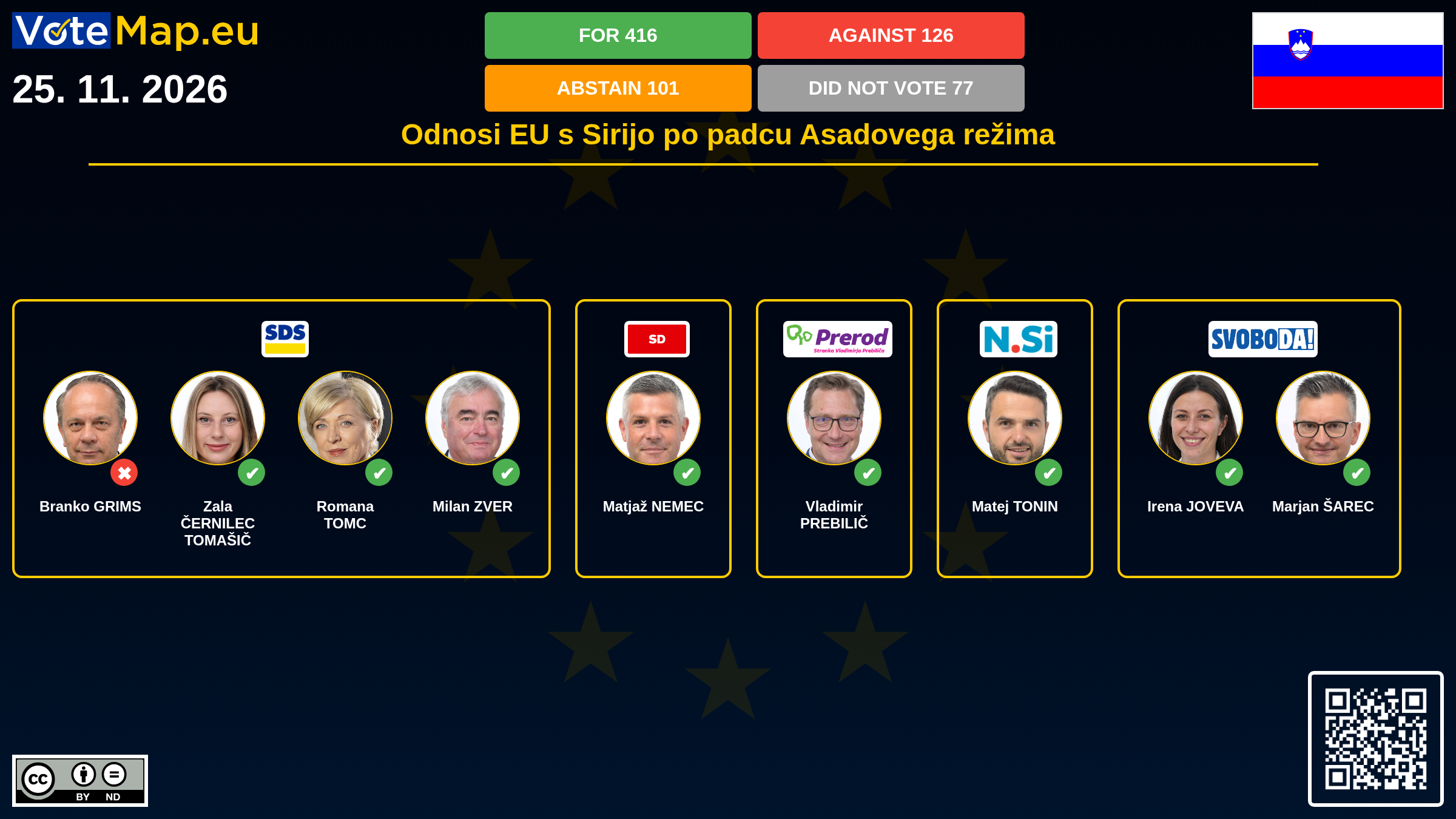
The resolution is based on a report by the Committee on Foreign Affairs (AFET), which Parliament drew up on its own initiative. The rapporteur was Nathalie Loiseau (Renew). The text sets out the conditions under which the EU is to cooperate with the Syrian transitional authorities following the fall of the Assad regime.
The resolution was adopted by 416 votes in favour, 126 against and 101 abstentions. The EPP voted in favour by an overwhelming majority (155 in favour, 3 against, 5 abstentions), as did the S&D (117 in favour, 1 against, 4 abstentions). Renew gave its rapporteur’s report 69 votes in favour, with no votes against and 2 MEPs abstaining. The Greens/EFA voted unanimously in favour, with all 46 voting members. The EPP, S&D, Renew and Greens/EFA – in other words, the pro-European majority – alone accounted for 387 votes in favour of the resolution. The Left, the far left, also voted in favour (22 in favour, 1 against, 12 abstentions).
The PfE (71 against, 7 abstentions, none in favour) and the ESN (24 against, 1 in favour) voted against. The ECR largely abstained: 61 of its 77 MEPs abstained, 13 voted against and 3 in favour. Abstaining does not mean voting against, so the ECR, PfE and ESN – that is, the far right – did not act as a single bloc in this vote. The EPP did not align itself with any of them.
The core of the text concerns the conditions. The EU’s political engagement, financial assistance, support for recovery, the suspension of sanctions and the resumption of institutional cooperation are to remain reversible, linked to measurable criteria and strictly conditional upon a genuine, pluralistic and inclusive transition: progress in the rule of law, constitutional reform, reform of the security forces, the fight against corruption, respect for human rights, the protection of minorities and coming to terms with the past. The Commission and the European External Action Service are to monitor compliance with these conditions and report to Parliament on this at least once a year. The resolution notes the lifting of EU economic sanctions against Syria as a step to support the transition. However, any suspension or lifting of restrictive measures must remain conditional, reversible and subject to ongoing assessment.
The return of refugees must be safe, dignified, informed and voluntary. The resolution makes this conditional upon the transitional authorities establishing the necessary political, security and legal conditions and ruling out forced conscription, arbitrary detention and the persecution of returnees. It strongly condemns the targeted violence against Alawites, Druze, Kurds, Christians and other communities since the beginning of 2025, including extrajudicial executions, enforced disappearances and attacks on places of worship, and calls for minorities to be enshrined in the future Syrian constitution.
The resolution names external actors directly. It condemns Russia for having granted political asylum to Bashar al-Assad and his family and for continuing to host them, and for obstructing the course of justice: interfering with international investigations and vetoing UN Security Council resolutions on war crimes committed by the Assad regime and by Russia. It is concerned about Russia’s ongoing efforts to re-establish its influence in Syria. It warns that Iran is seeking to exploit the power vacuum to re-establish intelligence networks and smuggling routes. It remains concerned about the ‘ongoing military intervention and aggression’ by Turkish forces and the armed groups they support, and calls for an immediate halt to military operations and the withdrawal of Turkish forces from Syrian territory. It expresses concern that Israel is occupying part of Syrian territory, calls for the withdrawal of Israeli forces from Syrian territories which it has occupied or over which it has extended its control since the fall of the Assad regime, including the former UN buffer zone, and calls on the Israeli authorities to withdraw plans to relocate thousands more Israeli civilians to the occupied Golan Heights.
Rapporteur Nathalie Loiseau (Renew) stated in her group’s press release: “Syria’s recent past has been a tragedy. The country’s present is fragile and its future remains uncertain.”
We collect and visually present data publicly available at the page of European Parliament. Votemap.eu denies any responsibility for possible inconsistencies of the data or its changes after the publication.
Descriptions are created using DeepL Translate machine translation. We apologize for any possible imperfections or inconvenience.